OpenBOM New SuiteApp Achieves ‘Built for NetSuite’ Status
OpenBOM, a leading manufacturing data management system provider, announced today that its OpenBOM SuiteApp has achieved the ‘Built for NetSuite’ status. The new SuiteApp, built using the Oracle NetSuite SuiteCloud Computing Platform, is a real-time collaborative product-centric data management system that provides advanced engineering bill of material CAD integrations for NetSuite.
CoLab becomes first Atlantic Canadian company to join Silicon Valley’s most prestigious accelerator: Y Combinator
CoLab Software announced today that it is the first Atlantic Canadian company to be accepted into Y Combinator. The company plans to double the size of its team by year end to meet growing customer demand.
Desktop Metal Launches Workflow Management System for Additive Fabrication Shops at RAPID + TCT 2019
Desktop Metal today announced the launch of Fab Flow™, a fully-integrated prototype ordering and workflow management system for internal additive fabrication shops. The customizable tool, now available in free and standard packages, empowers shop managers with increased efficiency, visibility and control over their workflows, and design engineers with managed 3D design communication and graphical version tracking of their parts. During RAPID + TCT 2019 in Detroit, Desktop Metal will offer live demonstrations of Fab Flow™ at booth #1041.
Bureau Veritas Unlocks Smart Torqueing Capabilities with the Launch of the First Digital Integrated Bolted Joints Management Solution
Bureau Veritas a world-leader in testing, inspection, and certification (TIC) services, today announced a key digital addition to its integrated solution for bolted joints management, powered by the Cumulus Smart Torque System. The solution will integrate into the company's industrial inspection services portfolio and be delivered to clients worldwide.
IrisVR Takes Home Technological Innovation of the Year at the 2019 New York City Construction Awards
One of our primary goals at IrisVR is to supply the construction industry with powerful and easy to use virtual reality tools.
That’s why we’re so excited to announce that we won Technological Innovation of the Year at the 2019 New York City Construction Awards on March 12th.
Google is Using 3D Printers to Re-Create Ancient Artifacts
One of 3D printing's biggest selling points has always been the ability to create objects that would otherwise be difficult or impossible to built with more traditional methods. A new collaboration between Google and industrial 3D printer manufacturer Stratasys, however, finds the companies working to re-create the familiar.
Onshape brings cloud-native CAD and PDM to your engineering teams. AMC Bridge connects it to the rest of your
business. Since 2013, we have helped manufacturers extend Onshape beyond out-of-the-box functionality by integrating
it with PLM, ERP, and MES systems, migrating legacy data, and supporting adoption across complex engineering
environments.
AMC Bridge, a software technology company serving engineering, manufacturing, and construction organizations, announced the successful delivery of a digital thread initiative for a leading research and engineering organization supporting complex, mission-critical programs. The engagement established a connected digital engineering environment that links systems engineering, design, manufacturing, and testing data, creating a scalable foundation for improved decision-making and future AI adoption.
Engineering organizations developing complex products increasingly struggle to maintain visibility and traceability across requirements, system architecture, manufacturing, and validation activities. As programs grow in complexity, disconnected engineering tools and siloed data often create gaps in communication, slow decision-making, and limit the ability to understand the true status of products and programs.
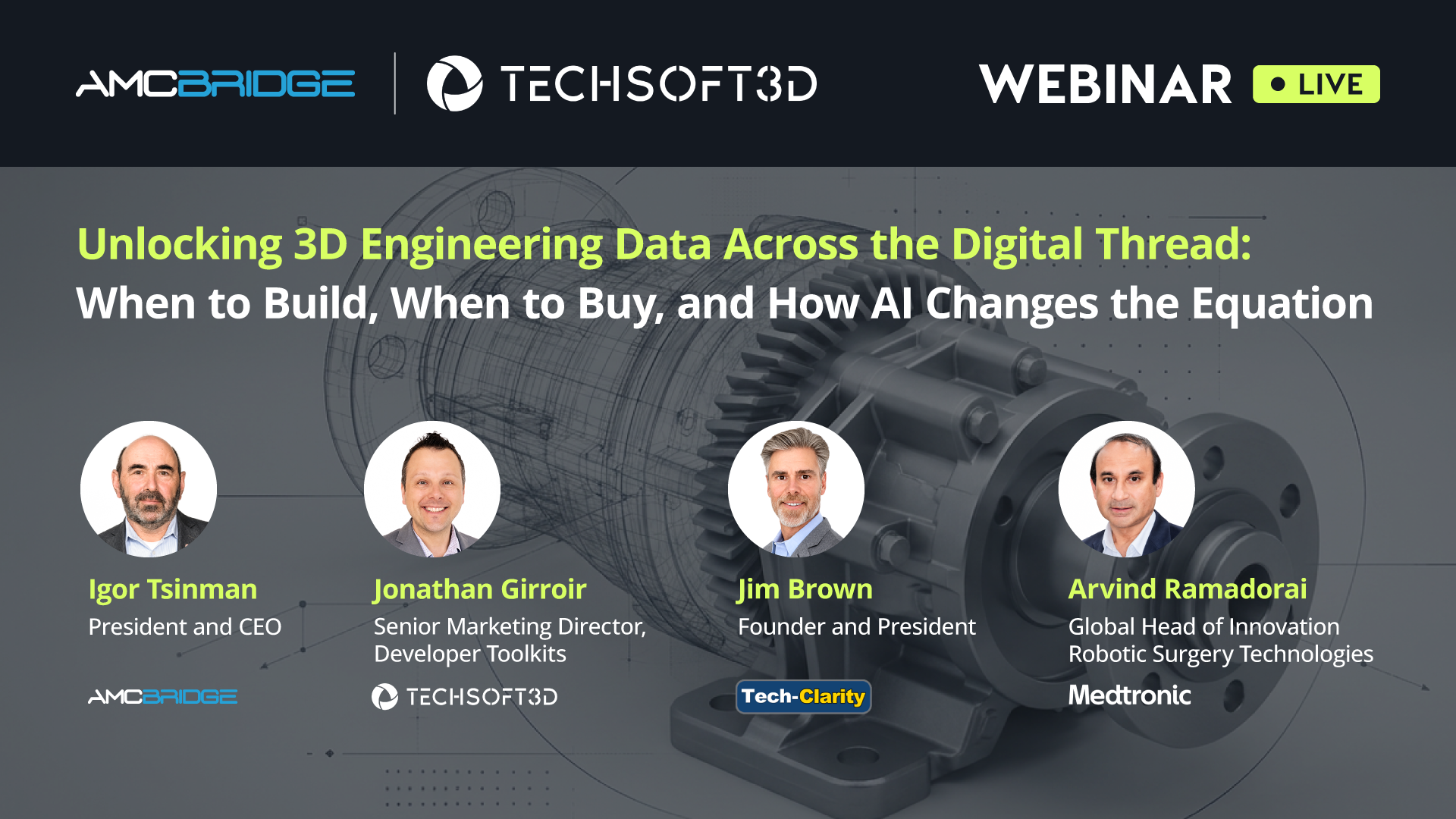
Industry experts from Tech Soft 3D, Medtronic, AMC Bridge, and Tech-Clarity explore the growing demand for 3D engineering data across the digital thread and reveal how leading manufacturers are approaching the build-or-buy decision. The webinar examines the technical and business challenges of making engineering data accessible across the enterprise, the surprising reality of hybrid build-and-buy strategies, and the factors driving organizations to rethink traditional software decisions.