Exa: Small changes in vehicle exterior can clear vision, ADAS sensors, cameras
Meeting OEM tolerances and restoring a vehicle’s exterior appearance precisely might become even more important as automakers place more sensors and cameras on its surface.
Custom-Parts Marketplace Xometry Raises $25 Million in New Funding
Xometry Inc., an online marketplace for custom-manufactured parts, has acquired rival firm MakeTime Inc. and raised $25 million to fuel future expansion.The deal creates what Xometry says is the industry’s largest distributed on-demand manufacturing network, with more than 2,300 domestic manufacturers and machine shops that make prototypes and smaller runs of parts for customers including BMW AG BMW -1.95% and General Electric Co. , which are also investors.
Zemax prepares for new phase of growth with acquisition by global private equity firm
We are pleased to announce that EQT Partners acquired Zemax from Arlington Capital Partners. The company will continue to be led by Mark Nicholson, CEO, and our headquarters will remain in Kirkland. With the new influx of investment, we will continue to drive growth in OpticStudio and LensMechanix as well as seek new opportunities to innovate and deliver solutions that offer customers new ways to bring products to market faster at a reduced cost.
Dassault Systèmes and Centric Software Come Together to Accelerate Digital Transformation of Fashion, Retail and Consumer Goods Companies: Dassault Systèmes to Acquire Majority Stake in Centric Software
Dassault Systèmes (Euronext Paris: #13065, DSY.PA) today announced that it has entered into a definitive agreement to acquire a majority stake in Centric Software, a privately-owned industry market leader driving digital transformation with software innovation in the fashion, apparel, luxury and retail sectors. With this investment, Dassault Systèmes aims to accelerate the digital transformation of companies seeking solutions for the increasingly complex development of collections that respond to today’s on-trend and on-demand consumers, representing a multi-billion dollar total addressable market.
Aras Introduces Flexible Effectivity to Solve How Manufacturers Manage Complex Effectivity at Scale
Aras®, the leader in open product lifecycle management (PLM) software for the enterprise, today announced availability of version 11 SP14 of the Aras PLM Platform, which features Effectivity Services. Aras delivers a flexible, multi-factor approach to effectivity to enable manufacturers to manage complex effectivity at scale. Using Aras’ Effectivity Services, organizations are able to create and apply customized effectivity rules and manage all variants in a single, dynamic product structure. The result is a massively simplified approach for engineering teams to specify and manage large numbers of variants and customized product configurations, collaborate on designs, and incorporate effectivity into the Digital Thread.
Today we are introducing Onshape Enterprise, a new premium edition of Onshape designed for modern companies with sophisticated design processes that include multiple contributors across multiple locations. Onshape Enterprise helps these companies accelerate their unique design processes while protecting IP to a degree that is impossible with old CAD and PDM.
Onshape brings cloud-native CAD and PDM to your engineering teams. AMC Bridge connects it to the rest of your
business. Since 2013, we have helped manufacturers extend Onshape beyond out-of-the-box functionality by integrating
it with PLM, ERP, and MES systems, migrating legacy data, and supporting adoption across complex engineering
environments.
AMC Bridge, a software technology company serving engineering, manufacturing, and construction organizations, announced the successful delivery of a digital thread initiative for a leading research and engineering organization supporting complex, mission-critical programs. The engagement established a connected digital engineering environment that links systems engineering, design, manufacturing, and testing data, creating a scalable foundation for improved decision-making and future AI adoption.
Engineering organizations developing complex products increasingly struggle to maintain visibility and traceability across requirements, system architecture, manufacturing, and validation activities. As programs grow in complexity, disconnected engineering tools and siloed data often create gaps in communication, slow decision-making, and limit the ability to understand the true status of products and programs.
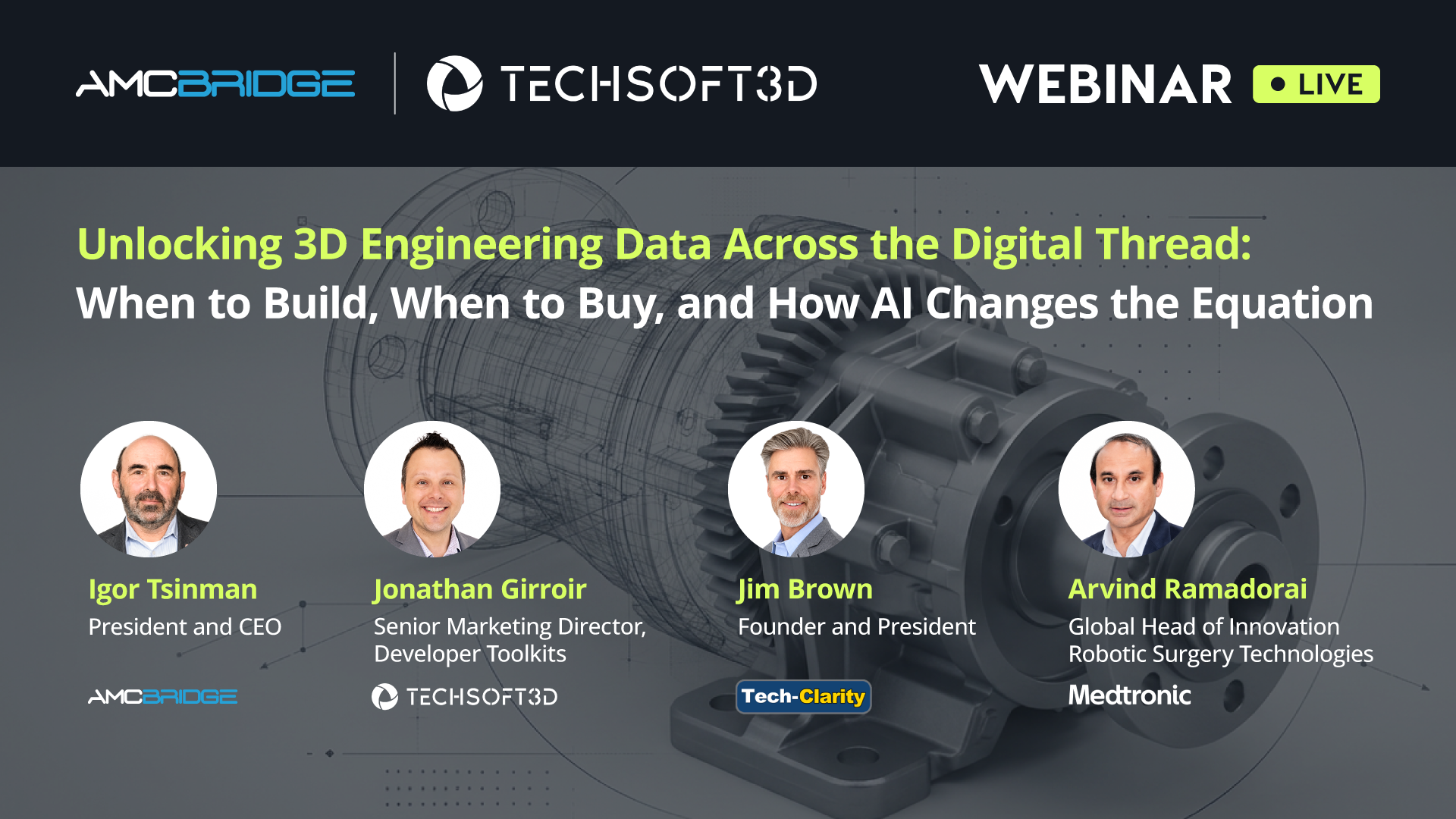
Industry experts from Tech Soft 3D, Medtronic, AMC Bridge, and Tech-Clarity explore the growing demand for 3D engineering data across the digital thread and reveal how leading manufacturers are approaching the build-or-buy decision. The webinar examines the technical and business challenges of making engineering data accessible across the enterprise, the surprising reality of hybrid build-and-buy strategies, and the factors driving organizations to rethink traditional software decisions.