MecSoft launches VisualCAMc Beta – production CAM for Onshape!
MecSoft Corporation, the developer of computer aided manufacturing (CAM) software solutions, announces the launch of a free Beta program for VisualCAMc, its cloud hosted, fully integrated CAM add-on app for Onshape. The beta is free and available for anyone who has an Onshape account and is approved by MecSoft.
“On Par with the cPDm Leaders” – Why Aras is Recognized as a New Member of the PLM Elite
In the PLM business, being named to the "PLM Mind Share Leaders" list by analyst firm CIMdata, is a big step. This exclusive group contains the major players in this fairly static world. So far, only Dassault Systèmes, Siemens PLM, Autodesk, SAP, PTC, IBM and Oracle have passed through the eye of the needle.
Spatial Corp Leverages 3D Modeling Expertise to Enable Anything, Anywhere Viewing of CAD Models
Spatial Corp, the leading provider of 3D software development toolkits (SDKs) for design, manufacturing, and engineering solutions, and a subsidiary of Dassault Systèmes (Euronext Paris: #13065, DSY.PA), today announced an easy-to-use, universal 3D modeling web viewer from Spatial Corp. This viewer leverages the power of Spatial’s 3D InterOp suite to provide web-based access to CAD files. Through this viewer, users have the ability to access and view a wide range of industry-standard CAD formats on any browser-compatible device.
Aras Named PLM Mindshare Leader by Industry Analyst Firm CIMdata
Aras® was named a “PLM Mindshare Leader” by CIMdata, the leading independent global strategic management consulting and research authority focused exclusively on the PLM market. Aras was recognized in the CIMdata 2017 Executive PLM Market Report based on the company’s industry vision, platform approach, and the impact that Aras is having in the market.
New 3D multi-phase flow simulation technology makes it possible to predict the flow of both oil and water through rocks using only rotary sidewall cores. Doing less with more is a mantra in low-price environments. Reducing reservoir uncertainty is simultaneously a driving need when devising production plans, so its vital to know as much as possible about how much oil is in the ground and how fluids will move through the reservoir rocks.
AMC Bridge, a trusted software technology partner for engineering, manufacturing, and construction enterprises, continues strengthening its collaboration with Bentley Systems, Incorporated (Nasdaq: BSY), the infrastructure engineering software company, through its listing in the Bentley Ecosystem Catalog, a centralized resource that helps infrastructure professionals discover complementary applications, data solutions, and professional services to streamline workflows and improve project delivery.
Onshape brings cloud-native CAD and PDM to your engineering teams. AMC Bridge connects it to the rest of your
business. Since 2013, we have helped manufacturers extend Onshape beyond out-of-the-box functionality by integrating
it with PLM, ERP, and MES systems, migrating legacy data, and supporting adoption across complex engineering
environments.
AMC Bridge, a software technology company serving engineering, manufacturing, and construction organizations, announced the successful delivery of a digital thread initiative for a leading research and engineering organization supporting complex, mission-critical programs. The engagement established a connected digital engineering environment that links systems engineering, design, manufacturing, and testing data, creating a scalable foundation for improved decision-making and future AI adoption.
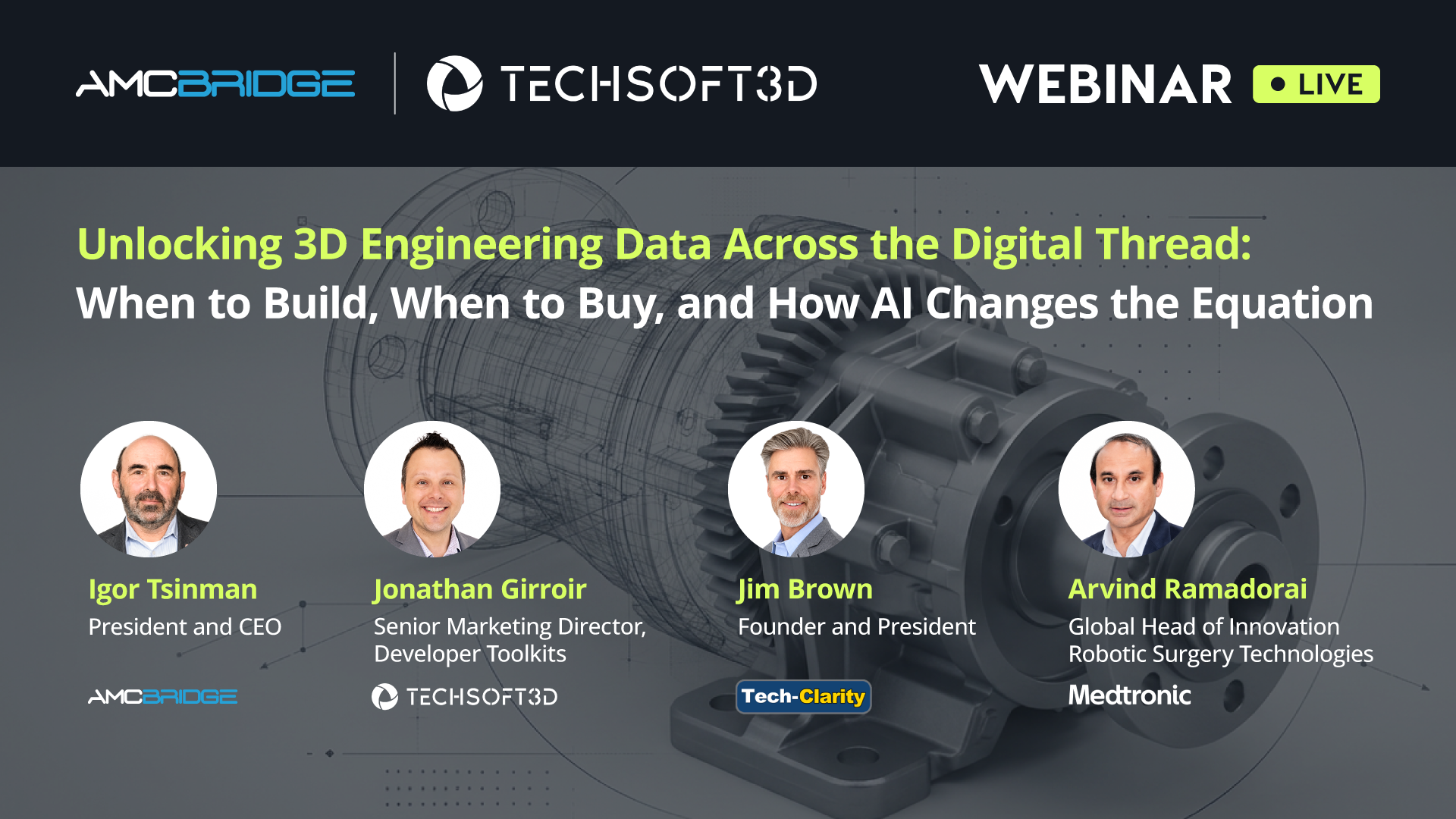
Industry experts from Tech Soft 3D, Medtronic, AMC Bridge, and Tech-Clarity explore the growing demand for 3D engineering data across the digital thread and reveal how leading manufacturers are approaching the build-or-buy decision. The webinar examines the technical and business challenges of making engineering data accessible across the enterprise, the surprising reality of hybrid build-and-buy strategies, and the factors driving organizations to rethink traditional software decisions.