TOP 10 Manufacturing Intelligence Solution Providers 2016
Manufacturers are transitioning into an era undergoing a matemorphosis termed as Industry 4.0 - the deluge of emerging and disruptive technologies like cloud computing, automation, cyber physical systems, big data and more.
Aras Innovator Demo: Visual Collaboration
Visual collaboration provides the fastest, simplest way to collaborate securely across disciplines, locations and organizations.
Lots of questions have come in over the forum, twitter, and other channels about the T-splines functionality that we slipped into the Experimental section in 1.1. While this is not a comprehensive description of the capabilities, we’d like to give a little more information on what this functionality is about, how you can use it, and where it’s going.
openBoM, the world’s first cloud BOM management tool specifically designed to help manufacturing companies manage and track BOMs across organizational and geographic boundaries is now available as an app seamlessly integrated within the Onshape environment, the world’s first full cloud CAD solution.
In the age of the Internet of Things (IoT), todays' manufacturer faces unprecedented change. Complex, connected products incorporate hardware, software, and electronics into systems that communicate with other products, services and people via mobile or hard-wired Internet connections.
Robust, dynamic, easily configurable — hardly words most would use to describe traditional PDM (product data management) or PLM (product lifecycle management). But when Microsoft set out to consolidate and standardize its hardware groups on a core product development platform, its alternative approach — building on top of an open, cloud-based PLM platform and leveraging its expertise in agile methodologies — led to a global deployment completed in record time and packed with more functionality than its previous PLM systems.
AMC Bridge, a trusted software technology partner for engineering, manufacturing, and construction enterprises, continues strengthening its collaboration with Bentley Systems, Incorporated (Nasdaq: BSY), the infrastructure engineering software company, through its listing in the Bentley Ecosystem Catalog, a centralized resource that helps infrastructure professionals discover complementary applications, data solutions, and professional services to streamline workflows and improve project delivery.
Onshape brings cloud-native CAD and PDM to your engineering teams. AMC Bridge connects it to the rest of your
business. Since 2013, we have helped manufacturers extend Onshape beyond out-of-the-box functionality by integrating
it with PLM, ERP, and MES systems, migrating legacy data, and supporting adoption across complex engineering
environments.
AMC Bridge, a software technology company serving engineering, manufacturing, and construction organizations, announced the successful delivery of a digital thread initiative for a leading research and engineering organization supporting complex, mission-critical programs. The engagement established a connected digital engineering environment that links systems engineering, design, manufacturing, and testing data, creating a scalable foundation for improved decision-making and future AI adoption.
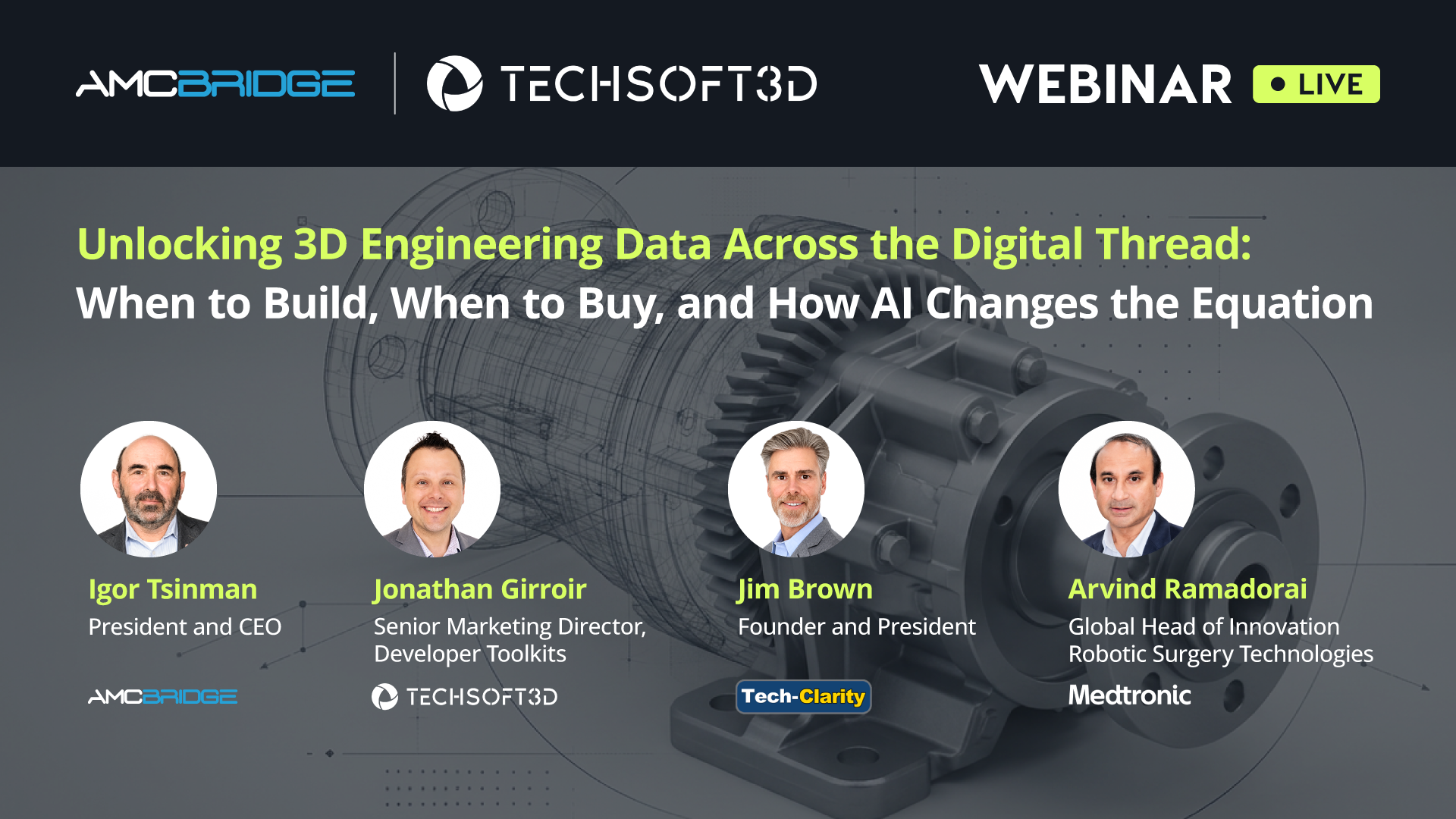
Industry experts from Tech Soft 3D, Medtronic, AMC Bridge, and Tech-Clarity explore the growing demand for 3D engineering data across the digital thread and reveal how leading manufacturers are approaching the build-or-buy decision. The webinar examines the technical and business challenges of making engineering data accessible across the enterprise, the surprising reality of hybrid build-and-buy strategies, and the factors driving organizations to rethink traditional software decisions.