National Electric Vehicle Sweden AB Selects Aras as Global PLM Backbone and Minerva as Implementation Partner
Aras®, the next leader in enterprise Product Lifecycle Management (PLM) software, today announced that National Electric Vehicle Sweden AB (Nevs), a Swedish holding company that develops electric vehicles and sustainable mobility services, has selected Aras Innovator® as the global PLM backbone.
Toshiba Machine Selects Aras Innovator to Improve Design Processes, Enhance Product Quality, and Manage Global Product Information
Aras®, the next leader in enterprise Product Lifecycle Management (PLM) software, today announced that Toshiba Machine has selected Aras Innovator® to streamline design and manufacturing processes as the company continues to expand internationally.
Autodesk Envisions New Automotive Workflow, Refines Alias for Future Generations
This week, Autodesk published a blog post announcing its strategy to cater to the auto industry with a bundle comprising Autodesk Alias, VRED, and Studio Wall.
Taking bill of materials management into the cloud allows small engineering companies—such as hardware startups–and contract manufacturers to track and share data and offers easy BOM data import from design tools, said the two co-founders of openBoM.
Autodesk just announced that it has acquired Solid Angle, maker of Arnold, a ray-tracing image renderer for high-quality 3D animation and visual effects creation. Arnold was co-developed with Sony Pictures Imageworks and is now their main renderer. Autodesk says Arnold (not an awesome product name, but must have a great backstory) is used by over “500 studios and thousands of independent artists” including on project such as the Academy Award-winning films Ex Machina and The Martian and the Emmy Award-winning Game of Thrones.
Autodesk Formit 360 - SketchUp to Revit Converter - Game Changer
At one point in time, Autodesk was seriously considering purchasing SketchUp from Google. In the end, it was purchased by Trimble. Afterwards, many of the SketchUp development team left to join Autodesk. This team created Autodesk FormIt , a product for creative sketch design.
AMC Bridge, a trusted software technology partner for engineering, manufacturing, and construction enterprises, continues strengthening its collaboration with Bentley Systems, Incorporated (Nasdaq: BSY), the infrastructure engineering software company, through its listing in the Bentley Ecosystem Catalog, a centralized resource that helps infrastructure professionals discover complementary applications, data solutions, and professional services to streamline workflows and improve project delivery.
Onshape brings cloud-native CAD and PDM to your engineering teams. AMC Bridge connects it to the rest of your
business. Since 2013, we have helped manufacturers extend Onshape beyond out-of-the-box functionality by integrating
it with PLM, ERP, and MES systems, migrating legacy data, and supporting adoption across complex engineering
environments.
AMC Bridge, a software technology company serving engineering, manufacturing, and construction organizations, announced the successful delivery of a digital thread initiative for a leading research and engineering organization supporting complex, mission-critical programs. The engagement established a connected digital engineering environment that links systems engineering, design, manufacturing, and testing data, creating a scalable foundation for improved decision-making and future AI adoption.
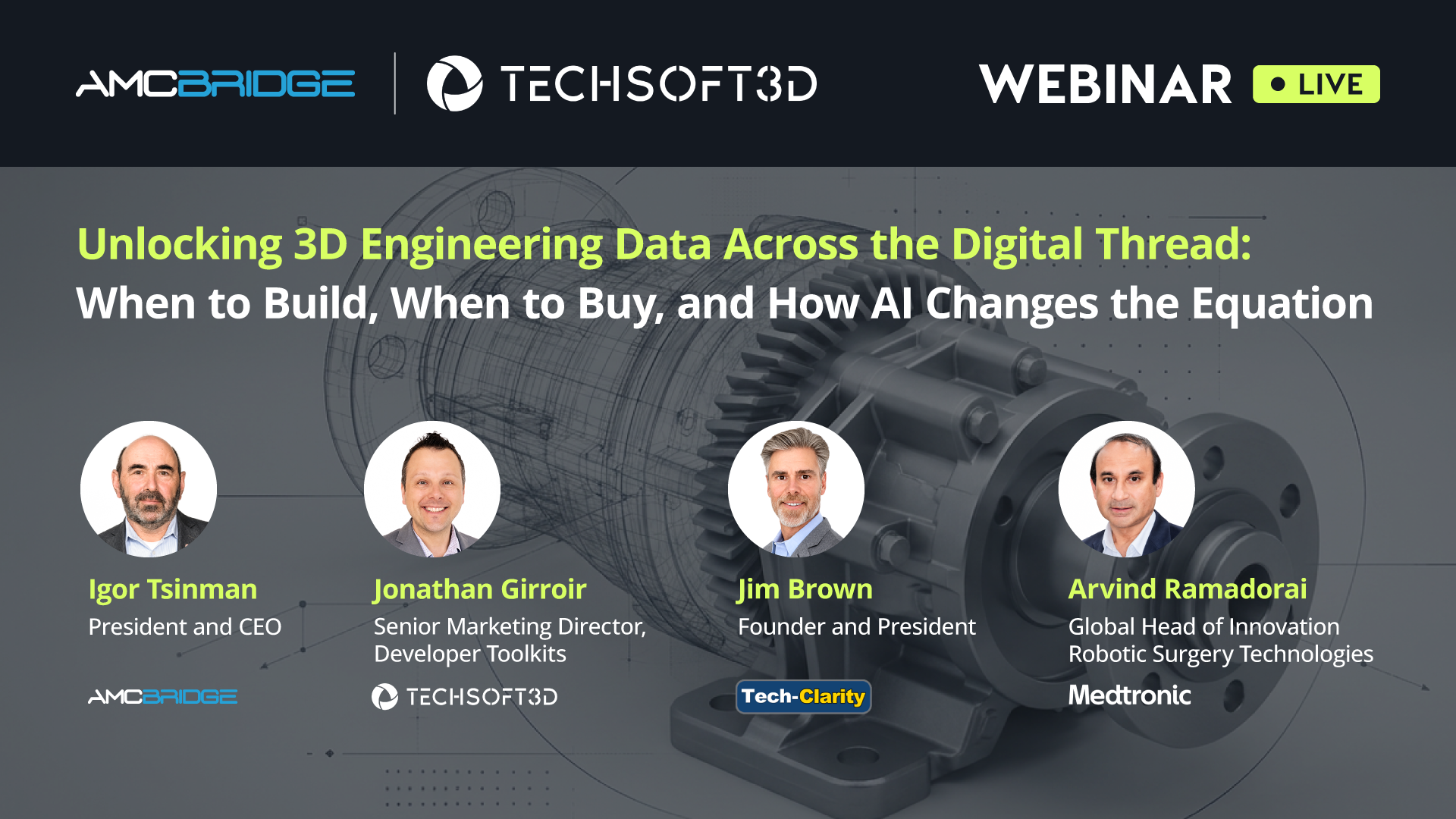
Industry experts from Tech Soft 3D, Medtronic, AMC Bridge, and Tech-Clarity explore the growing demand for 3D engineering data across the digital thread and reveal how leading manufacturers are approaching the build-or-buy decision. The webinar examines the technical and business challenges of making engineering data accessible across the enterprise, the surprising reality of hybrid build-and-buy strategies, and the factors driving organizations to rethink traditional software decisions.