Autodesk Tandem Digital Twin Platform for AEC Beta Released
Bob Bray, Autodesk Sr. Dir. and General Manager of Autodesk Tandem, announced the availability of the new Digital Twin platform Autodesk Tandem beta release on the Autodesk Feedback Community.
Despite the challenging conditions that defined 2020, from catastrophic weather and wildfires to social unrest and a global pandemic, HappyNest reported 10X growth across critical KPIs. Having closed a $1.5MM seed round, HappyNest continued its national expansion tripling the number of production partners launching 37 locations in 19 different states.
Zemax Releases OpticStudio, OpticsBuilder v21.1
Zemax announced the latest release of their flagship software, OpticStudio, and OpticsBuilder. Continuing their commitment to deliver regular updates to their customers, Zemax will deliver three product releases in 2021, the first in January (21.1) followed by May (21.2) and September (21.3) releases.
OpenBOM Delivers Advanced SaaS Data Management to Autodesk Fusion 360 Users
OpenBOM expands one-click BOM process to support bi-directional data handover and brings OpenBOM production planning and purchase order functions to Autodesk Fusion 360 customers.
Desktop Metal is now officially traded on the NYSE stock market
Desktop Metal announced it was going public last August by entering a definitive business combination agreement with Trine Acquisition Corp. and HPS Investment Partners.
Onshape brings cloud-native CAD and PDM to your engineering teams. AMC Bridge connects it to the rest of your
business. Since 2013, we have helped manufacturers extend Onshape beyond out-of-the-box functionality by integrating
it with PLM, ERP, and MES systems, migrating legacy data, and supporting adoption across complex engineering
environments.
AMC Bridge, a software technology company serving engineering, manufacturing, and construction organizations, announced the successful delivery of a digital thread initiative for a leading research and engineering organization supporting complex, mission-critical programs. The engagement established a connected digital engineering environment that links systems engineering, design, manufacturing, and testing data, creating a scalable foundation for improved decision-making and future AI adoption.
Engineering organizations developing complex products increasingly struggle to maintain visibility and traceability across requirements, system architecture, manufacturing, and validation activities. As programs grow in complexity, disconnected engineering tools and siloed data often create gaps in communication, slow decision-making, and limit the ability to understand the true status of products and programs.
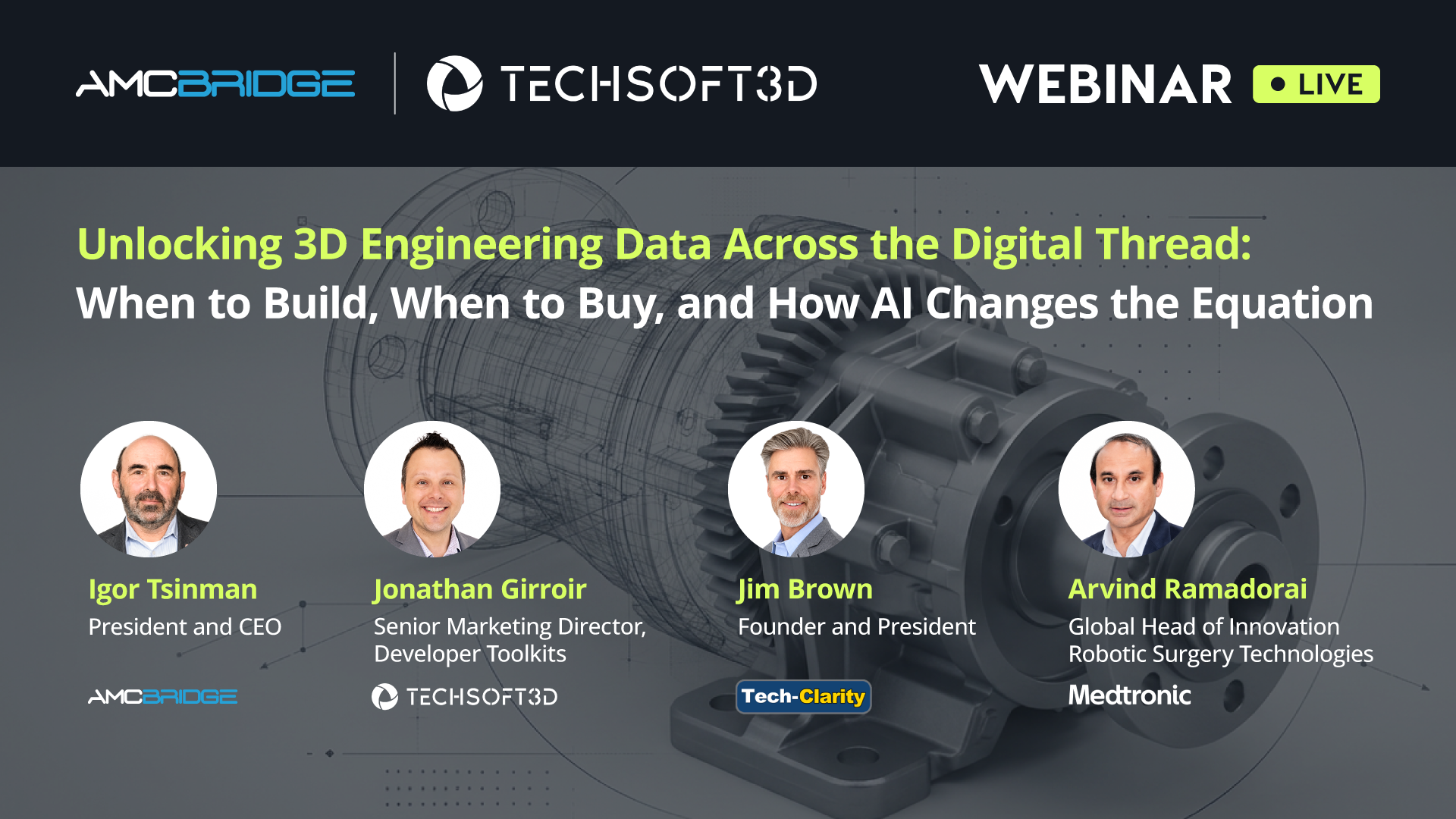
Industry experts from Tech Soft 3D, Medtronic, AMC Bridge, and Tech-Clarity explore the growing demand for 3D engineering data across the digital thread and reveal how leading manufacturers are approaching the build-or-buy decision. The webinar examines the technical and business challenges of making engineering data accessible across the enterprise, the surprising reality of hybrid build-and-buy strategies, and the factors driving organizations to rethink traditional software decisions.