Zemax is pleased to announce the latest release of our software, OpticStudio and OpticsBuilder. Version 21.2 of these products represents our second of three 2021 releases.
Desktop Metal Redefines Woodworking With New Wood 3D Printing Technology
Industrial 3D printer OEM Desktop Metal has launched its subsidiary Forust, a brand focused on 3D printing functional end-use wood parts via binder jetting.
MecSoft Corp. announces the release of CAMJam 2021, the Video Training Companion for their popular VisualCAD/CAM, RhinoCAM and VisualCAM for SOLIDWORKS desktop milling modules.
PTC Adds Generative Design and AR to Atlas Cloud Portfolio
PTC added two more products to its newly formed software as a service (SaaS) division, Atlas, formed after the company’s acquisition of Onshape. Joining Onshape are Creo Generative Design Extension and Vuforia Expert Capture, the first to follow Onshape in PTC’s new Atlas platform.
Aras, the only resilient platform provider for digital industrial applications, announced the release of Systems Architecture, a new application that coordinates systems model definition with tool independent data from all engineering disciplines including mechanical, software, electronics, simulation, and more.
Leveraging Parasolid for reliable design operations in generative engineering
Siemens solution helps ELISE customers to reduce product development times by 80 percent or more.
Classic modeling procedures like blending, offsetting and tapering work time and again in Parasolid without fail.
Onshape brings cloud-native CAD and PDM to your engineering teams. AMC Bridge connects it to the rest of your
business. Since 2013, we have helped manufacturers extend Onshape beyond out-of-the-box functionality by integrating
it with PLM, ERP, and MES systems, migrating legacy data, and supporting adoption across complex engineering
environments.
AMC Bridge, a software technology company serving engineering, manufacturing, and construction organizations, announced the successful delivery of a digital thread initiative for a leading research and engineering organization supporting complex, mission-critical programs. The engagement established a connected digital engineering environment that links systems engineering, design, manufacturing, and testing data, creating a scalable foundation for improved decision-making and future AI adoption.
Engineering organizations developing complex products increasingly struggle to maintain visibility and traceability across requirements, system architecture, manufacturing, and validation activities. As programs grow in complexity, disconnected engineering tools and siloed data often create gaps in communication, slow decision-making, and limit the ability to understand the true status of products and programs.
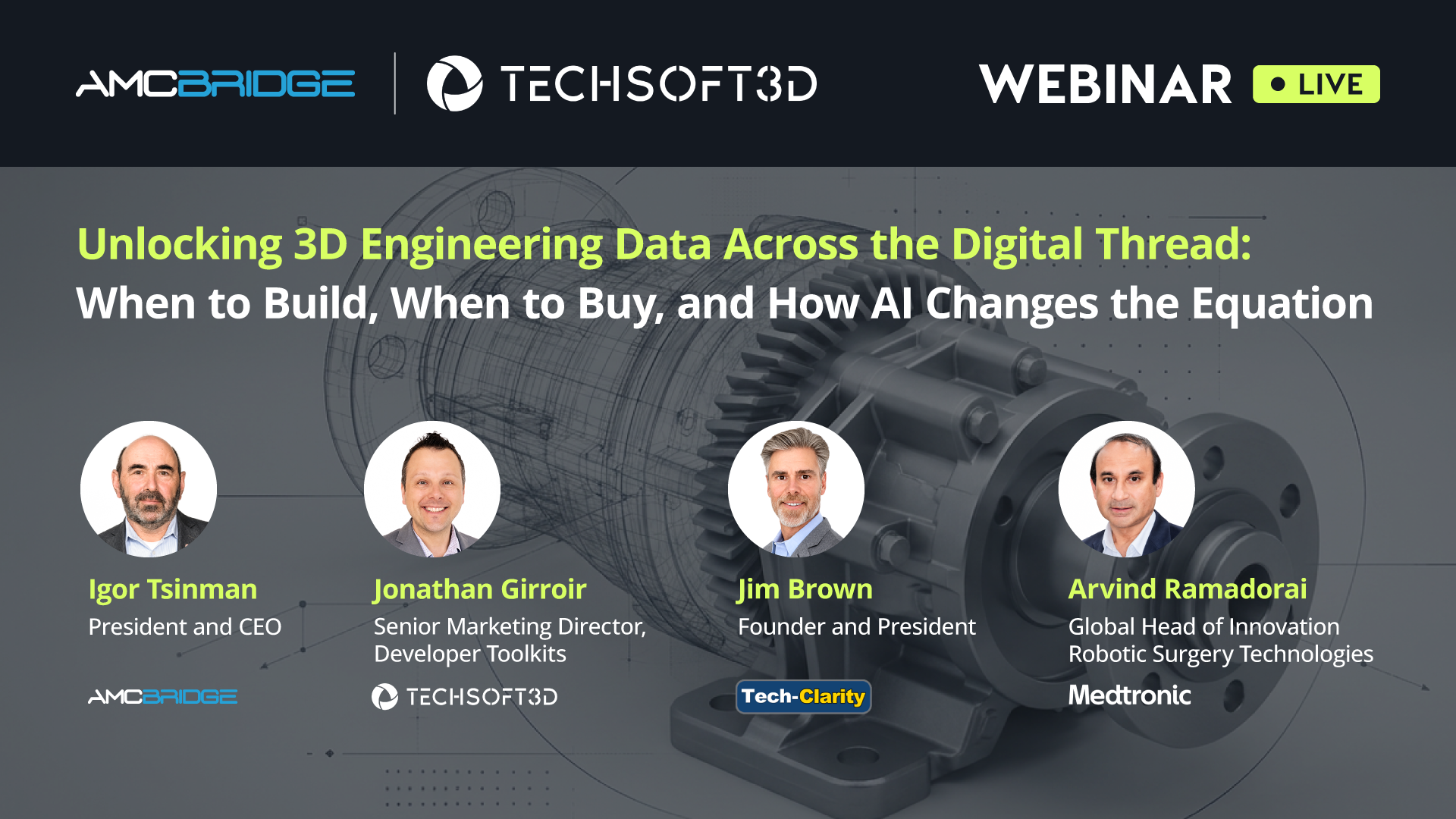
Industry experts from Tech Soft 3D, Medtronic, AMC Bridge, and Tech-Clarity explore the growing demand for 3D engineering data across the digital thread and reveal how leading manufacturers are approaching the build-or-buy decision. The webinar examines the technical and business challenges of making engineering data accessible across the enterprise, the surprising reality of hybrid build-and-buy strategies, and the factors driving organizations to rethink traditional software decisions.