MecSoft Corp. has announced the availability of VisualCAM 2022 for SOLIDWORKS, the latest version of MecSoft’s Gold certified CAM product for SOLIDWORKS 2018-2022.
Manufacturing companies are under significant pressure to transform their operations to stay competitive. Digital transformation is the ultimate way to change companies’ processes and to switch from outdated document-driven processes to connected data-driven processes.
Autodesk and CAD/CAM software specialist, ModuleWorks, announce a long-term partnership. The partnership enables Autodesk to continuously enhance and extend its Fusion 360 software platform with the powerful ModuleWorks toolpath calculation technology.
Cumulus WorkFlow is Now Available to All Sites and Users
Cumulus WorkFlow has graduated from beta and is now available for all users.
Desktop Metal Launches ETEC 3D Printer Brand Focused on Industrial Manufacturers
Desktop Metal, a global leader in additive manufacturing technologies for mass production, today announced the launch of ETEC, a new 3D printing brand that will enable EnvisionTEC, the original inventor of digital light processing (DLP) technology, to better connect with industrial customers.
This example shows how to create a 5-axis robot machining project for sculpting using RhinoCAM and RoboDK. This project uses a KUKA robot synchronized with a linear rail and a two-axis turntable (9 synchronized axes).
Onshape brings cloud-native CAD and PDM to your engineering teams. AMC Bridge connects it to the rest of your
business. Since 2013, we have helped manufacturers extend Onshape beyond out-of-the-box functionality by integrating
it with PLM, ERP, and MES systems, migrating legacy data, and supporting adoption across complex engineering
environments.
AMC Bridge, a software technology company serving engineering, manufacturing, and construction organizations, announced the successful delivery of a digital thread initiative for a leading research and engineering organization supporting complex, mission-critical programs. The engagement established a connected digital engineering environment that links systems engineering, design, manufacturing, and testing data, creating a scalable foundation for improved decision-making and future AI adoption.
Engineering organizations developing complex products increasingly struggle to maintain visibility and traceability across requirements, system architecture, manufacturing, and validation activities. As programs grow in complexity, disconnected engineering tools and siloed data often create gaps in communication, slow decision-making, and limit the ability to understand the true status of products and programs.
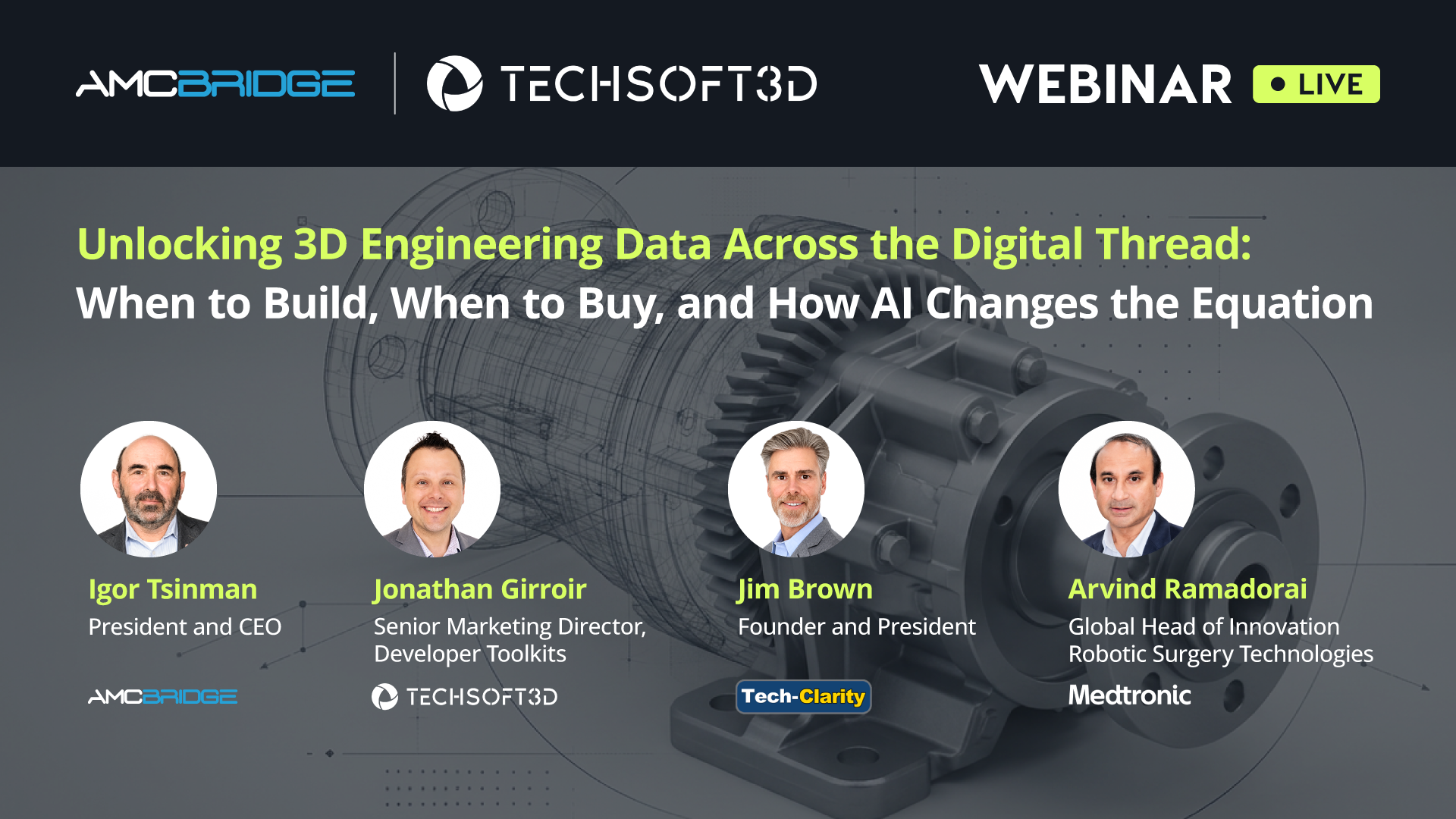
Industry experts from Tech Soft 3D, Medtronic, AMC Bridge, and Tech-Clarity explore the growing demand for 3D engineering data across the digital thread and reveal how leading manufacturers are approaching the build-or-buy decision. The webinar examines the technical and business challenges of making engineering data accessible across the enterprise, the surprising reality of hybrid build-and-buy strategies, and the factors driving organizations to rethink traditional software decisions.