Desktop Metal has released DM HH Stainless Steel (DM HH-SS), a custom stainless steel alloy that combines high strength and hardness with corrosion resistance, for additive manufacturing on the Production System platform. Customers can now leverage the Production System’s Single Pass Jetting (SPJ) technology to produce DM HH-SS components at scale across a range of industries where high strength and hardness are required, including oil & gas, automotive, consumer products, and medical devices.
Aras Announces Minerva Merger for Best-in-Class PLM Functionality in Medical Devices and High-Tech Electronics
Aras, which provides the most powerful low-code platform with applications to design, build, and operate complex products, today announced the merger of Minerva Group, the leading Aras Innovator PLM implementation partner. Minerva brings best-in-class PLM functionality—built on the Aras platform—for medical devices and high-tech electronics companies. The company also brings extensive vertical industry expertise in automotive, aerospace, defense, and industrial equipment manufacturing, and will provide Aras with direct, local representation in the Nordic region and the Netherlands. The merger is effective immediately.
Desktop Metal Receives $7.9 Million System Order from Major German Car Maker for Mass Production of Automotive Components
Desktop Metal, a leader in mass production additive manufacturing (AM) solutions, announced that, the company has received a $7.9 million order for binder jet additive manufacturing systems from a major German car maker for the mass production of metal automotive powertrain components at scale.
Desktop Metal announced it has qualified D2 tool steel for the Studio System 2, an accessible metal 3D printing platform that offers customers the easiest way to print high-performance metal parts in low volumes for pre-production and end-use applications.
Stratasys Ltd., a leader in polymer 3D printing solutions, introduced the newest printer in the company’s growing portfolio of 3D printing solutions for the dental industry, the Stratasys Origin One Dental.
Onshape brings cloud-native CAD and PDM to your engineering teams. AMC Bridge connects it to the rest of your
business. Since 2013, we have helped manufacturers extend Onshape beyond out-of-the-box functionality by integrating
it with PLM, ERP, and MES systems, migrating legacy data, and supporting adoption across complex engineering
environments.
AMC Bridge, a software technology company serving engineering, manufacturing, and construction organizations, announced the successful delivery of a digital thread initiative for a leading research and engineering organization supporting complex, mission-critical programs. The engagement established a connected digital engineering environment that links systems engineering, design, manufacturing, and testing data, creating a scalable foundation for improved decision-making and future AI adoption.
Engineering organizations developing complex products increasingly struggle to maintain visibility and traceability across requirements, system architecture, manufacturing, and validation activities. As programs grow in complexity, disconnected engineering tools and siloed data often create gaps in communication, slow decision-making, and limit the ability to understand the true status of products and programs.
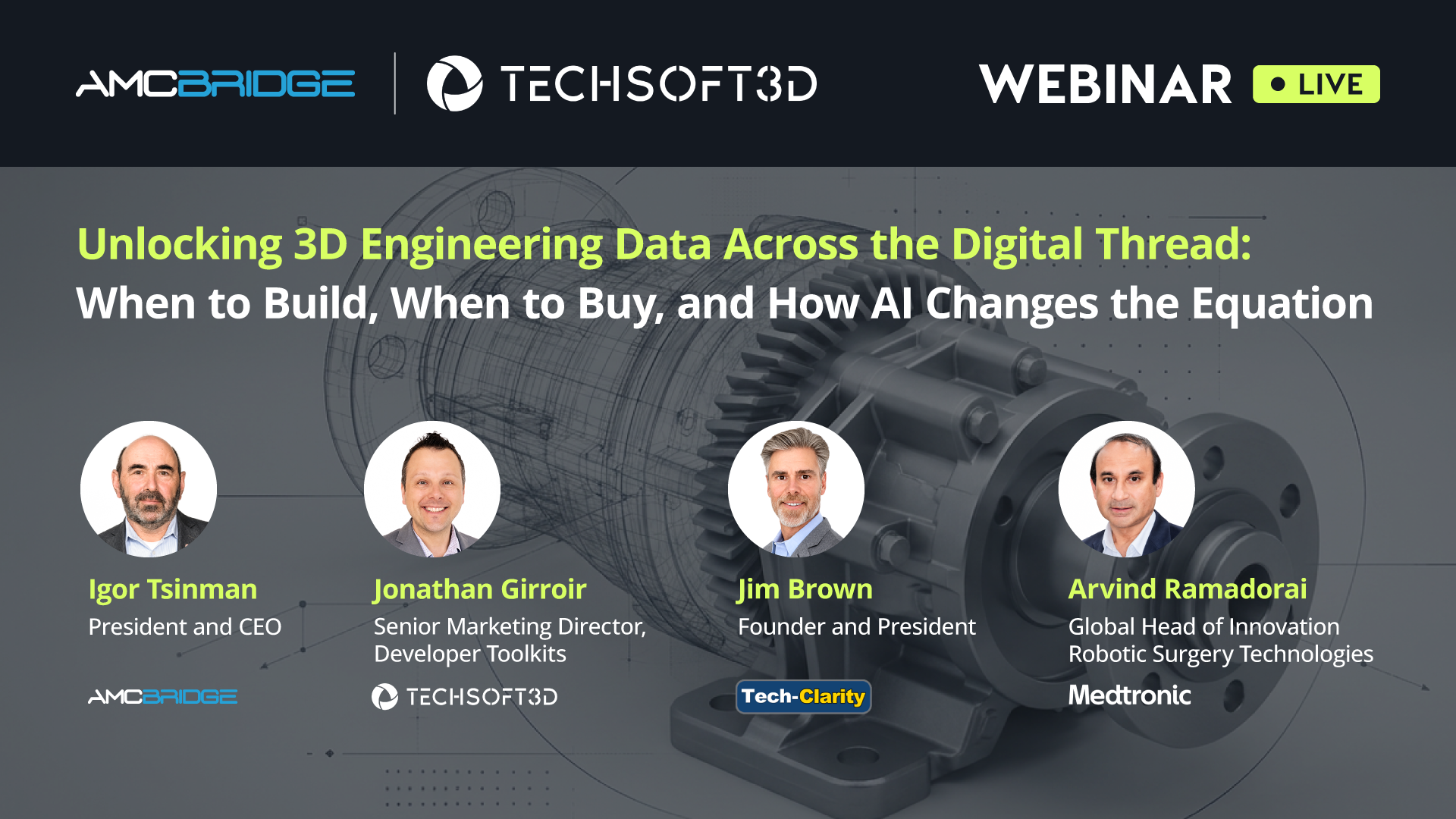
Industry experts from Tech Soft 3D, Medtronic, AMC Bridge, and Tech-Clarity explore the growing demand for 3D engineering data across the digital thread and reveal how leading manufacturers are approaching the build-or-buy decision. The webinar examines the technical and business challenges of making engineering data accessible across the enterprise, the surprising reality of hybrid build-and-buy strategies, and the factors driving organizations to rethink traditional software decisions.