Waltham, MA—As demand for 3D engineering data expands beyond product design, organizations face an increasingly complex question: should they buy existing software, build a custom solution, or combine both approaches? To examine this challenge, Tech Soft 3D and AMC Bridge organized the webinar, “Unlocking 3D Engineering Data Across the Digital Thread: When to Build, When to Buy, and How AI Changes the Equation,” with Medtronic contributing an enterprise perspective to the discussion. The panel discussed how companies are extending 3D data across the enterprise, addressing interoperability and data continuity, and reconsidering custom software development as artificial intelligence changes its speed and economics.
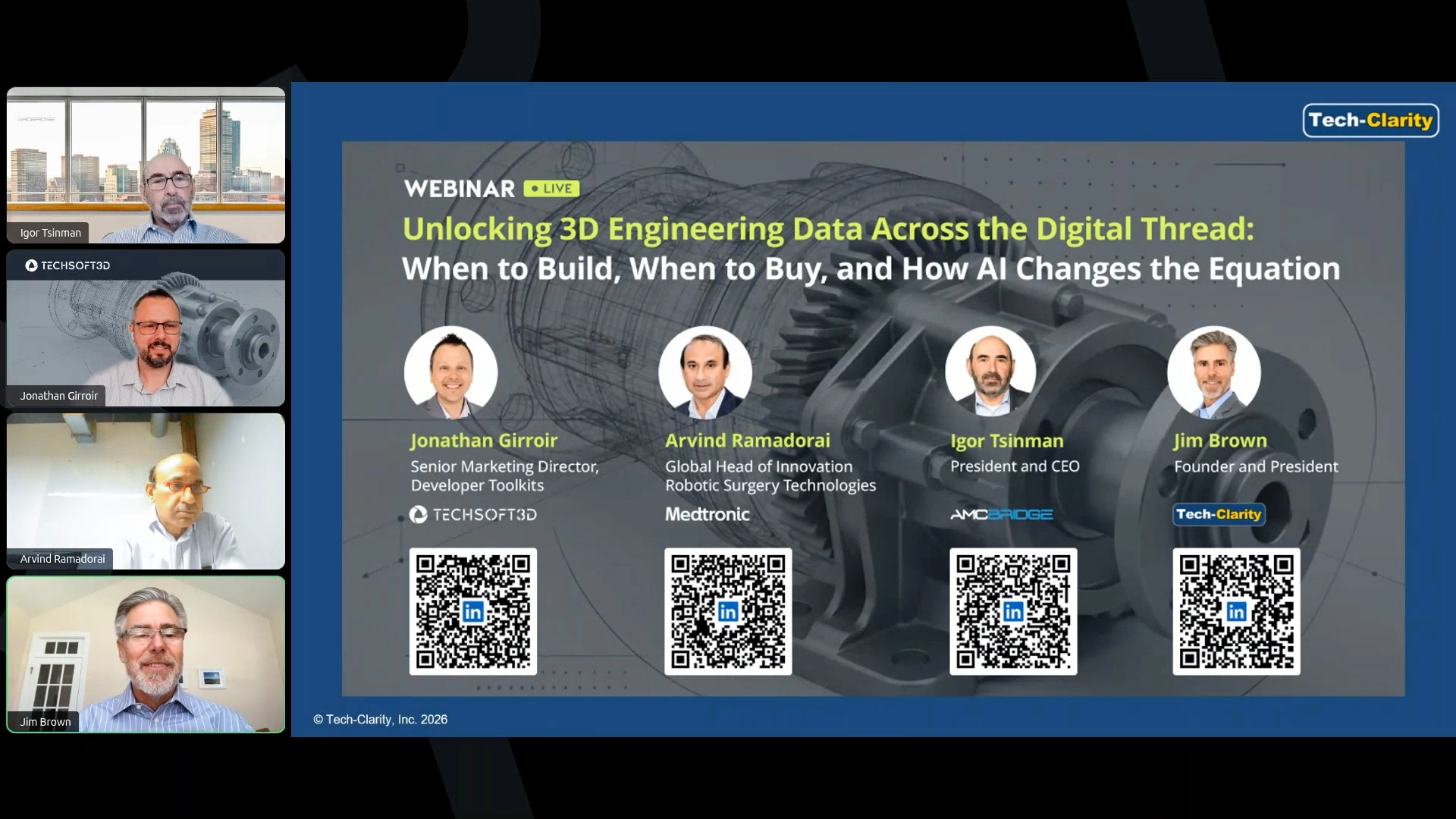
The session brought together Jonathan Girroir, Senior Marketing Director, Developer Toolkits, at Tech Soft 3D; Arvind Ramadorai, Global Head of Innovation, Robotic Surgery Technologies at Medtronic; and Igor Tsinman, President and CEO of AMC Bridge. The discussion was moderated by Jim Brown, Founder and President of Tech-Clarity.
If you missed the live session, the full webinar recording is available here.
3D Data Is Becoming an Enterprise-Wide Asset
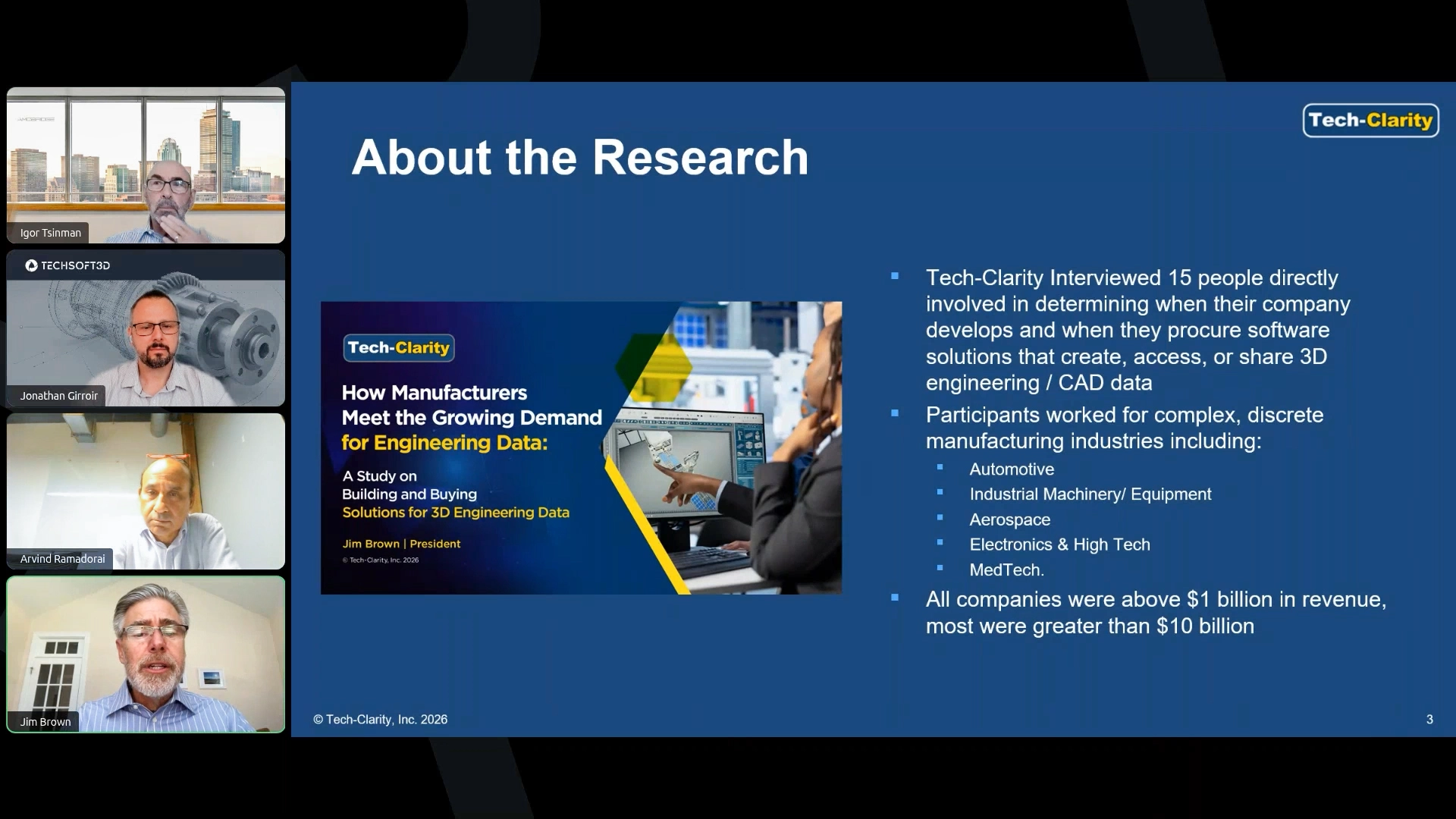
The webinar highlighted findings from recent industry research conducted by Tech-Clarity and commissioned by Tech Soft 3D, which examined how manufacturers approach software decisions related to creating, accessing, and sharing 3D engineering data.
The discussion began with the growing demand for access to 3D data outside traditional engineering environments.
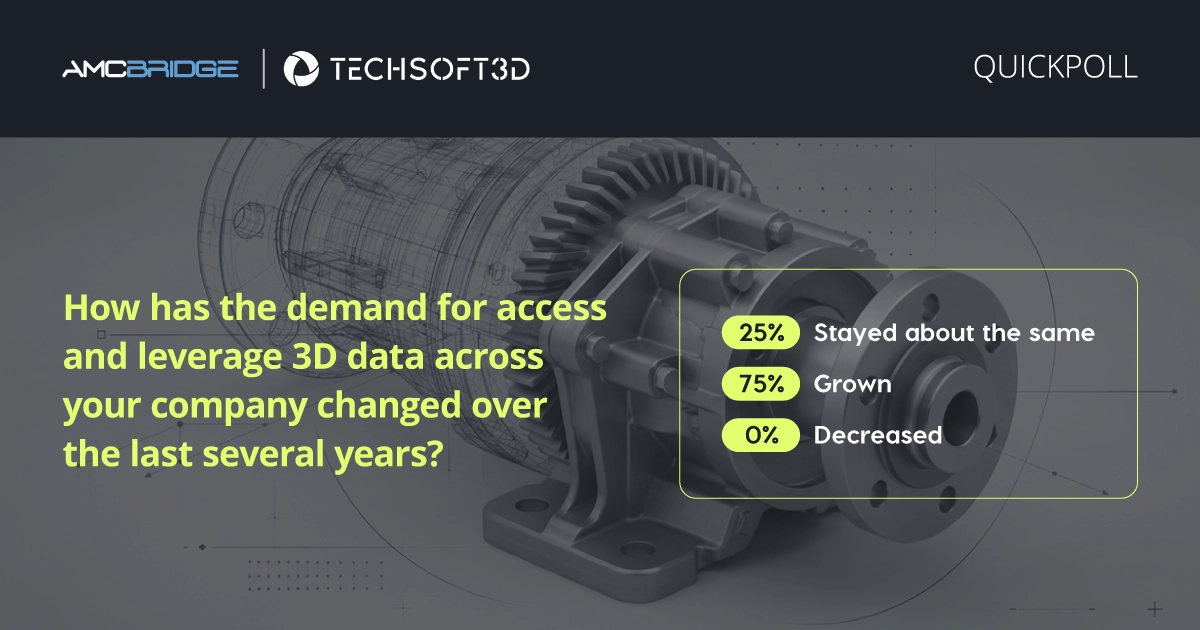
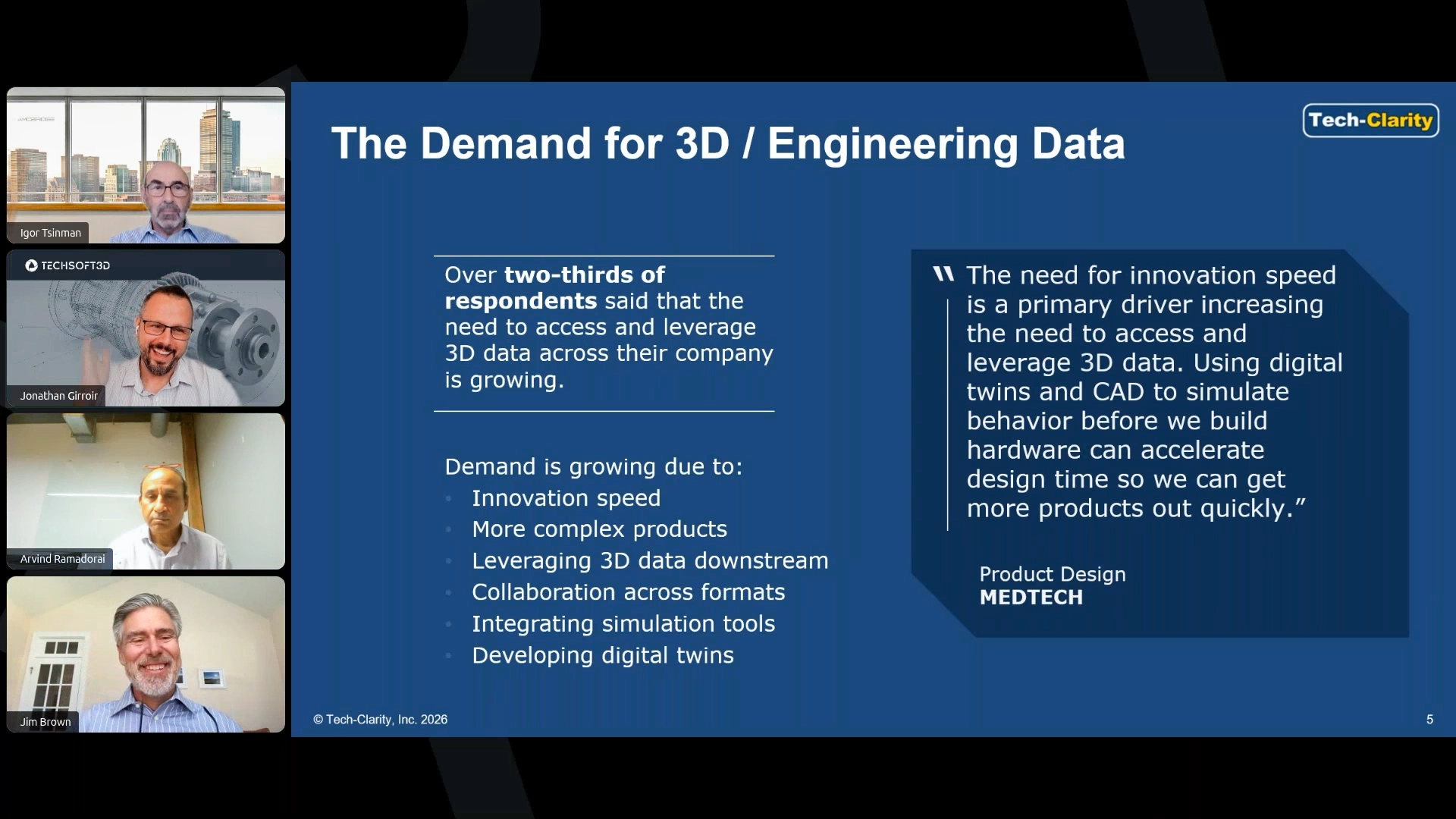
During an audience poll, three-quarters of respondents indicated that demand for accessing and using 3D data across their organizations had grown over the past several years. Jim Brown also noted that more than two-thirds of companies participating in the underlying Tech-Clarity research reported increased demand.
According to the panelists, 3D data is increasingly used across manufacturing, quality assurance, service, sales, procurement, training, and operations. This reflects its evolution from a specialized engineering resource into a broader enterprise asset.
Igor Tsinman explained that organizations have long wanted to extend 3D information upstream and downstream from product design. Historically, the cost of hardware and software limited broader access. While hardware has become less of a constraint, developing the software needed to make 3D data accessible within specialized workflows has remained costly and complex.
From the medical technology perspective, Arvind Ramadorai described 3D engineering data as critical across product development, regulatory submission, manufacturing, clinical use, training, and service. In regulated environments, the accuracy, traceability, and continuity of this information can be particularly important.
“What was once more in the domain of engineers is now more of an enterprise asset,” said Arvind.
The Digital Thread Is Advancing, but Progress Remains Gradual
The panelists reflected on the industry’s long-term movement toward model-based engineering, digital twins, and connected digital information across the product lifecycle.
Although companies have made progress, many still encounter gaps between the creation of a 3D model and its practical use across manufacturing, maintenance, service, and other downstream processes. In some cases, digital models coexist with document-based or paper-based workflows, illustrating that the transition toward a complete digital thread remains ongoing.
The discussion also addressed the importance of preserving engineering data over the life of a product or asset. In industries such as aerospace, digital information may need to remain available for decades, making archival strategy, format longevity, and data continuity important considerations.
Why 3D Engineering Data Remains Difficult to Integrate
Unlike conventional enterprise information, 3D engineering data contains complex geometric and mathematical representations together with manufacturing information, materials, feature definitions, and other valuable product information.
This information is often distributed across different CAD systems, proprietary formats, and vendor ecosystems. Moving data between applications can introduce translation problems or the loss of valuable information. Supporting several CAD systems may also require organizations to maintain multiple integration paths. The discussion also made clear that no single format has eliminated the broader interoperability challenge.
The exchange between mechanical CAD and building information modeling environments was also discussed. As construction becomes more connected with manufacturing and off-site production, organizations increasingly need to combine equipment and product information with architectural and BIM data. For many current use cases, this integration still requires targeted or custom solutions.
Build or Buy? In Practice, Organizations Often Need Both
The webinar’s central discussion focused on how organizations decide whether to buy commercial software or develop a custom application.
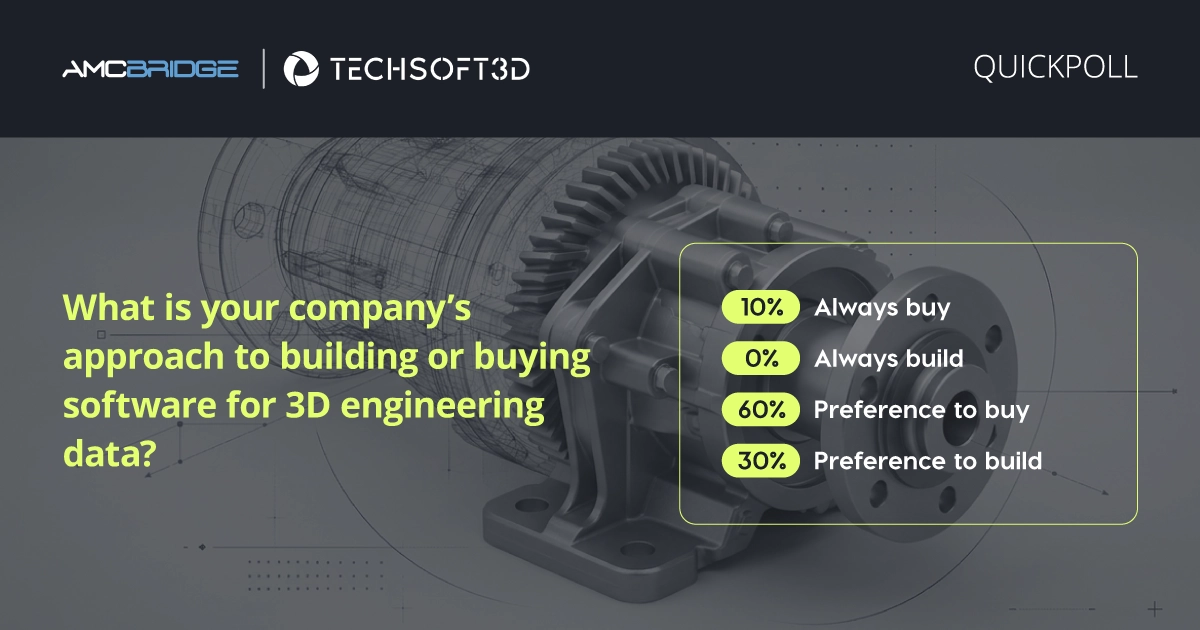
A second audience poll showed a preference for buying available solutions, while the underlying research indicated that almost all participating companies would also consider building software under the right conditions.
Commenting on the companies surveyed as part of the Tech-Clarity research, Jim Brown said: “First and foremost, it was a mix. There was definitely a preference to buy, but almost all of the companies we talked to said they would also choose to build under the right conditions.”
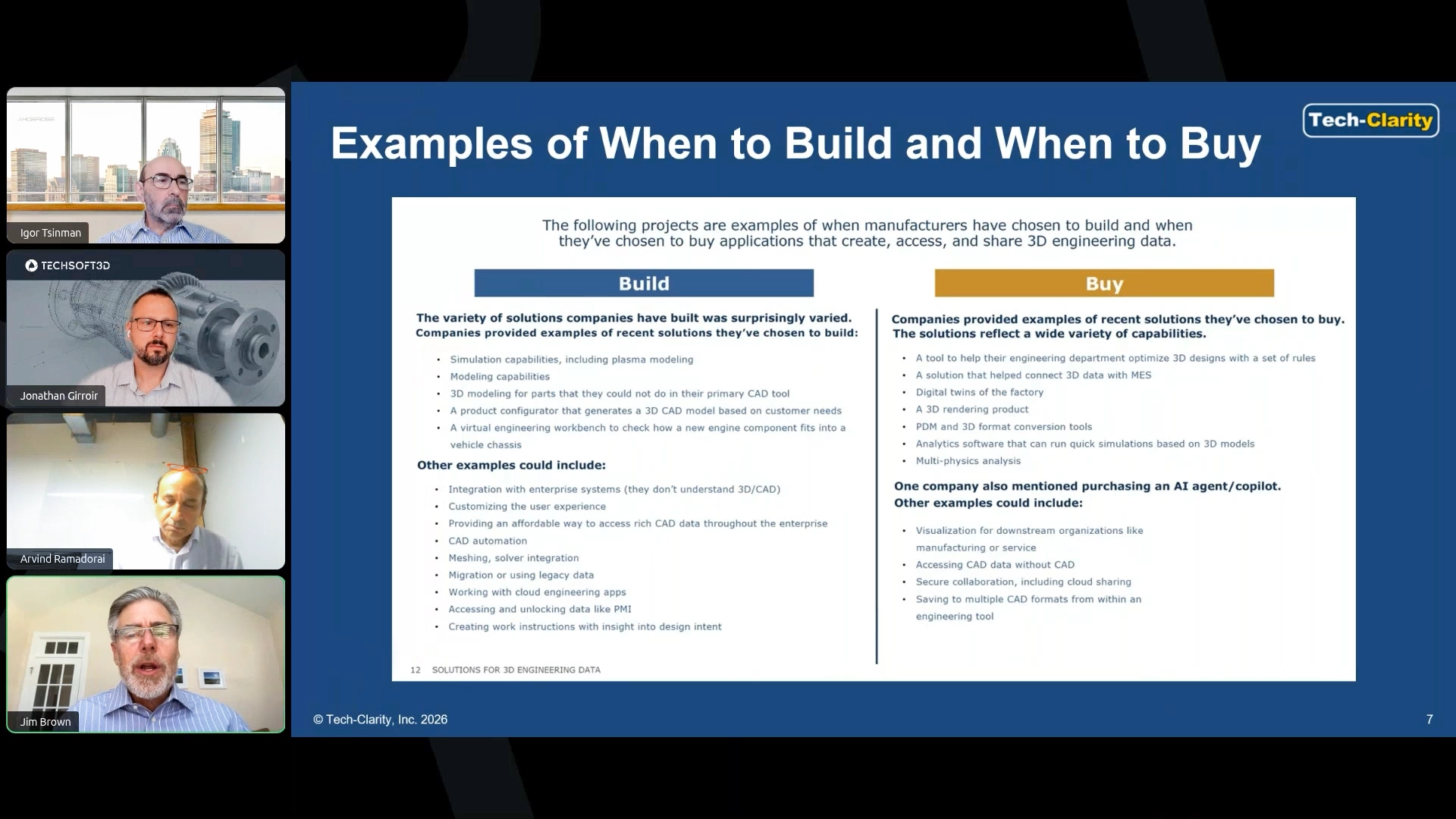
The panelists agreed that build and buy should not be treated as mutually exclusive strategies. Commercial products can provide mature, proven capabilities, while custom development can address specialized requirements, proprietary workflows, or gaps that standard products do not cover.
Igor Tsinman connected this decision to the 80/20 principle. Commercial technology can address standard or broadly shared requirements, while the remaining portion may contain an organization’s distinctive workflows, processes, and engineering know-how. These differentiating capabilities may not exist inside one application. Instead, they can extend across a connected workflow or digital thread.
This distinction is particularly important when a workflow represents competitive intellectual property. Organizations may choose to develop selected capabilities internally rather than disclose proprietary processes to a software vendor or wait for those capabilities to become part of a commercial product available to competitors.
The panel also discussed a growing middle ground between building and buying. Organizations can purchase established components or software development kits and use them as building blocks for tailored workflows. This blended approach gives companies greater control without requiring them to create every underlying capability from the beginning.
“You buy this component, but then you build with it, like building blocks, and you connect them,” said Jonathan Girroir. “Organizations still want that control, but they don’t want to build it all themselves.”
Build the Differentiating Workflow, Not the Commodity Foundation
The speakers identified several areas that organizations should approach cautiously when considering custom development.
Recreating mature technology such as geometry kernels or file translators can introduce substantial cost, complexity, and risk. These capabilities represent significant accumulated development expertise and are already available through established technology providers.
Regulatory-grade toolchains were also identified as an area where organizations should generally rely on validated solutions unless no suitable option exists.
Instead of rebuilding foundational technologies, the panel recommended assembling proven components around the workflows that make the organization distinctive.
“What is important is to put it together in a unique way that represents your company,” said Igor Tsinman. “Building the workflow that is tailored to your specific business can present a competitive advantage.”
AI Is Changing the Economics of Custom Development
AI emerged as an important factor affecting both sides of the build-or-buy decision.
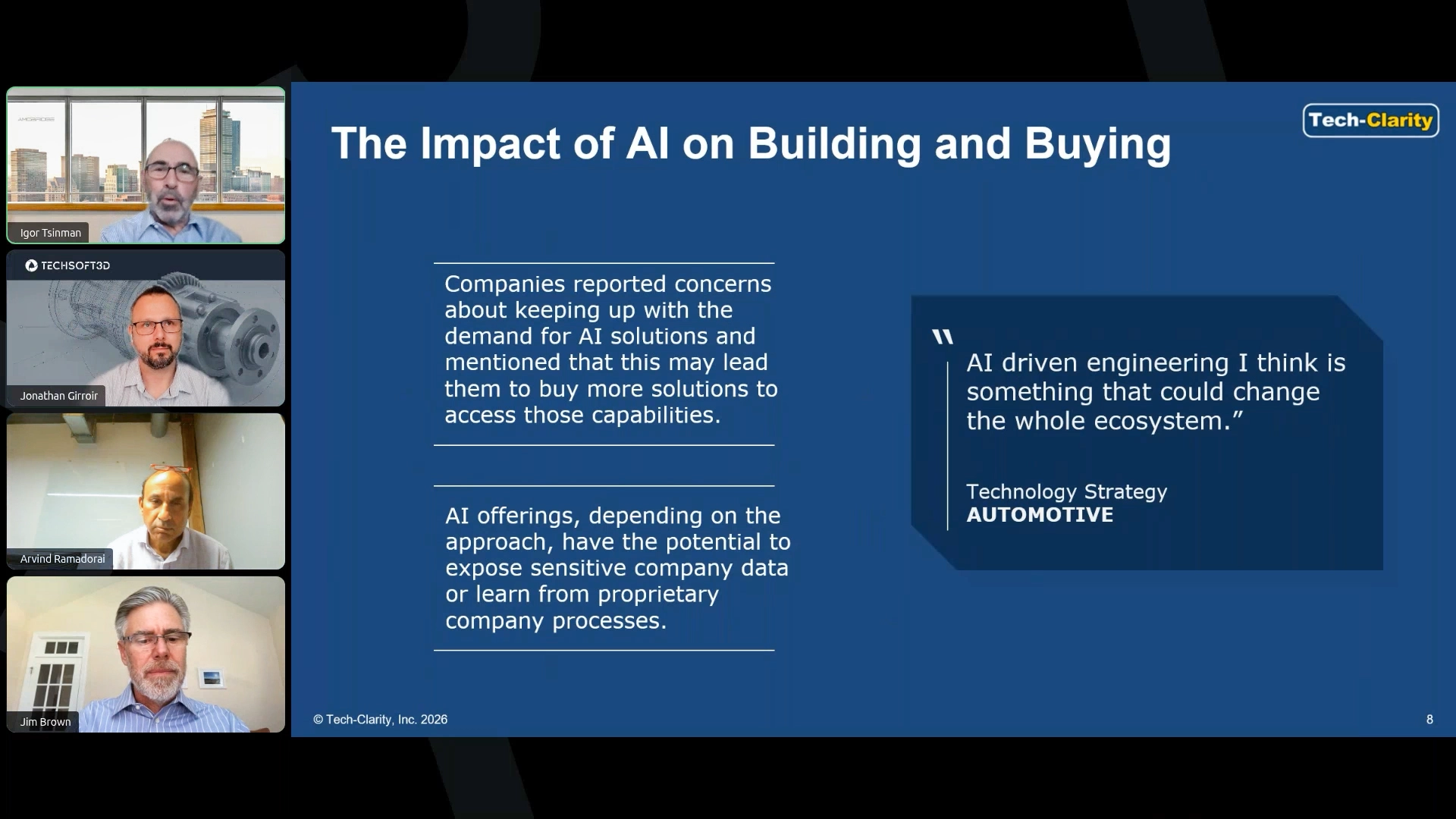
Commercial applications are becoming more capable as vendors incorporate AI into their products. At the same time, AI-assisted development tools and approaches significantly increase software development productivity, making it faster and more cost-effective to create specialized applications. The panelists discussed how this shift enables more companies to consider custom 3D solutions that were previously practical mainly for larger enterprises.
Igor Tsinman described two connected effects. First, useful AI applications need access to relevant engineering data, creating additional demand for systems that can connect fragmented 3D information. Second, AI reduces the development effort required for many general software tasks, lowering some of the barriers to implementing custom applications.
The panel cautioned against equating fast code generation with enterprise-ready software.
AI-assisted development dramatically facilitates the creation of prototypes, proofs of concept, and internal productivity tools. However, enterprise applications must also meet rigorous requirements for architecture, security, quality control, governance, maintainability, reliability, and long-term support.
"Creating code nowadays is very easy, and developing an impressive proof of concept, or even a prototype, can be a weekend job," said Igor Tsinman. "But there is still a long way to go from a proof of concept to an enterprise-grade application."
A More Strategic Build-Buy-Blend Decision
The discussion indicated that organizations should evaluate 3D software decisions according to the nature of the requirement rather than adopting a universal build-only or buy-only policy.
Commercial software remains the logical choice for mature and broadly shared capabilities. Custom development becomes more relevant when a requirement involves proprietary knowledge, differentiated workflows, specialized integration, or business processes that existing products do not adequately support. A blended strategy can connect both sides by combining established technology with company-specific applications and workflows.
AI is significantly expanding the possibilities available to organizations, but it does not eliminate the need for engineering expertise, thoughtful architecture, or disciplined enterprise software development.
The main takeaway from the discussion was clear: organizations should avoid recreating proven foundations, invest selectively in the workflows that distinguish their businesses, and treat AI as an accelerator within a broader technology and engineering strategy.
Acknowledgments and Helpful Links
AMC Bridge thanks Jim Brown of Tech-Clarity for moderating the session and Jonathan Girroir of Tech Soft 3D and Arvind Ramadorai of Medtronic for contributing their perspectives.
For those who missed the live session, view the complete webinar recording.
To keep track of upcoming webinars, conferences, and other industry events, visit the AMC Bridge events calendar.
The insights summarized in this article reflect the views expressed by the panelists and responses to audience questions during the live session.
All statements are paraphrased summaries of the panel discussion unless explicitly presented as direct quotations. Direct quotations have been lightly edited for clarity and concision without changing their intended meaning.
About Tech Soft 3D
Tech Soft 3D is the leading provider of engineering software development toolkits and industrial applications for CAD & CAE data conversion, visualization, and simulation. Established in 1996 and headquartered in Bend, Oregon, Tech Soft 3D has additional offices in the USA, France, England, Japan, Germany, and Norway. Tech Soft 3D is backed by investment firm Battery Ventures. For more information, please contact
About Medtronic
Medtronic plc, headquartered in Galway, Ireland, is the leading global healthcare technology company that boldly attacks the most challenging health problems facing humanity by searching out and finding solutions. Our Mission — to alleviate pain, restore health, and extend life — unites a global team of 95,000+ passionate people across more than 150 countries. Our technologies and therapies treat 70 health conditions and include cardiac devices, surgical robotics, insulin pumps, surgical tools, patient monitoring systems, and more. For more information on Medtronic (NYSE: MDT), visit www.Medtronic.com.
About Tech-Clarity
Tech-Clarity is an independent research firm dedicated to making the business value of technology clear. They analyze how companies improve innovation, product development, design, engineering, manufacturing, and service performance through the use of digital transformation, best practices, software technology, industrial automation, and IT services. Tech-Clarity believes that all parties in the engineering, product development, and manufacturing software community benefit from a clear understanding of how enterprise software helps drive better business performance. Tech-Clarity offers services to manufacturers, industrial companies, software vendors, and service providers to make the business value of technology clear. For more information, please visit http://www.tech-clarity.com.
About AMC Bridge
AMC Bridge is a trusted technology partner for engineering, manufacturing, and construction enterprises, whether they are actively pursuing AI-driven digital transformation or only beginning to recognize its potential. We help organizations to move beyond experimentation and achieve consistent ROI by delivering production-ready software and end-to-end solutions for their transformation journey.
We design, build, and integrate enterprise-grade software – applications, workflow extensions for CAD/PLM/BIM, data integrations, AI-enabled features – and deploy them with monitoring and lifecycle management so they remain reliable over time. Our services include assessing data readiness; preparing and unifying product and project data; and embedding AI into the workflows teams use every day. With 25+ years of industrial software expertise and deep ecosystem partnerships, including Aras, Autodesk, Bentley, Dassault Systemes, PTC, Siemens, Tech Soft 3D, and others, we empower enterprises to move confidently from experimentation to operational AI at scale. For more information, visit amcbridge.com.