Waltham, MA—As engineering software evolves toward increasingly complex, connected, and computation‑heavy workflows, development teams face a pressing challenge: how to build 3D solutions that remain robust, interoperable, and scalable today and in the future.
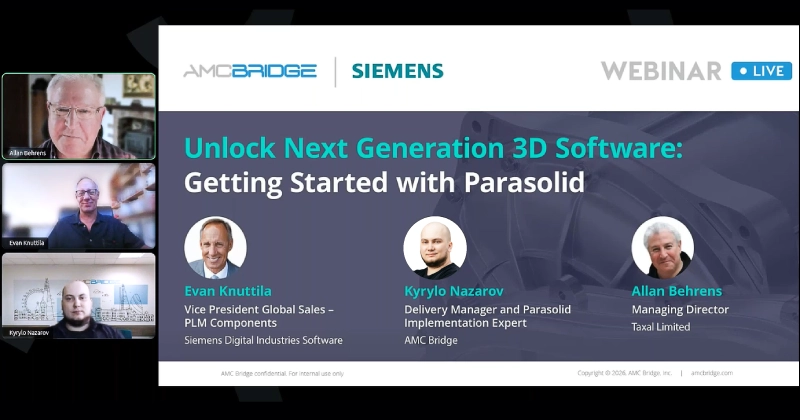
Addressing this challenge, Siemens Digital Industries Software and AMC Bridge co‑hosted the live webinar "Unlock Next Generation 3D Software: Getting Started with Parasolid," offering a deep look into how Parasolid empowers modern 3D applications and how AMC Bridge helps companies implement it successfully.
Moderated by Allan Behrens, Managing Director of Taxal Limited and experienced industry analyst, the discussion blended Siemens' perspective as the technology originator with AMC Bridge's practical experience implementing Parasolid across cloud, desktop, and hybrid platforms.
If you missed the live session, the full recording is available on AMC Bridge Webinars.
Parasolid: A Proven Geometry Engine Built for Modern Demands
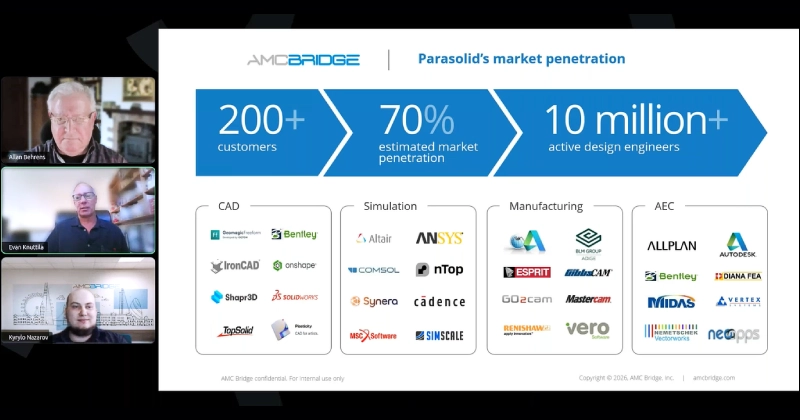
Parasolid's prevalence across the engineering ecosystem, spanning CAD, simulation, manufacturing, AEC, robotics, and generative design, underscores a core industry requirement: organizations need a geometry engine they can rely on at every stage of the product lifecycle.
"Parasolid isn't just a modeling kernel; it's the mathematical backbone behind many of the world's most advanced engineering tools," said Evan Knuttila, Vice President of Global Sales, PLM Components at Siemens Digital Industries Software.
"Its reliability, robustness, and proven behavior across platforms allow development teams to focus on innovation instead of fighting geometry issues."
Building on this foundation, Parasolid offers a set of capabilities intentionally designed to help software vendors deliver consistent performance, reduce development risks, and support the increasingly hybrid nature of modern 3D workflows.
This makes Parasolid not only a technical asset but also a strategic investment for organizations looking to scale high‑precision engineering solutions.
Key Reasons Parasolid Accelerates Business and Product Success
- Extensive modeling depth (1,000+ features) enabling precise, scalable geometry operations for every industry
- Convergent modeling that unifies B‑Rep and mesh data, reducing translation that unifies B-rep and facet data, both part of the Parasolid model structure and published XT format, eliminating conversion on-the-fly and enabling advanced hybrid workflows
- Implicit modeling and lattice support for next‑generation design and additive manufacturing
- Hybrid geometry capabilities that handle mixed data types in a single, stable environment
- Cross‑platform deployment options (desktop, cloud, mobile) supporting modern software architectures
- Open XT format, ensuring broad compatibility, representing an estimated 45% of global 3D CAD models
- Continuous, transparent innovation, driven by a dedicated Cambridge‑based team of mathematicians and developers
Evan emphasized that Parasolid’s evolution is rooted in real industry challenges: interoperability, model robustness, performance at scale, and support for increasingly complex geometry types.
Where Organizations See the Greatest Value in Parasolid Today
With the broader business benefits Parasolid brings to organizations, particularly those expanding their use of advanced modeling, simulation, or multi‑tool engineering workflows, attendees were asked to identify which areas of their Parasolid usage they were most interested in strengthening. A live poll revealed the following priorities:
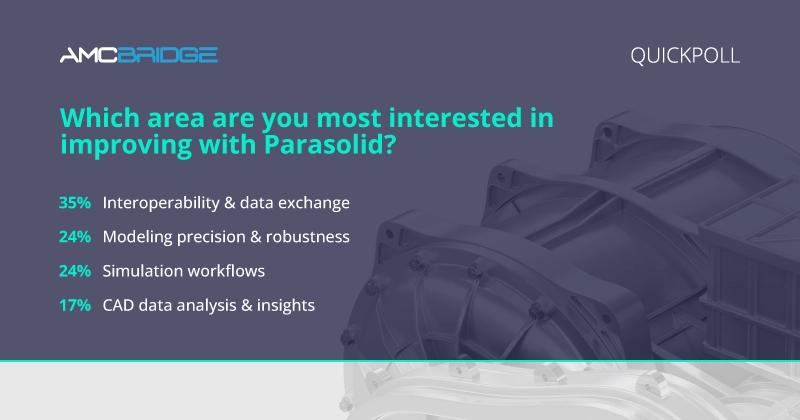
This reflects a diverse and strategically aligned set of needs, highlighting how organizations increasingly rely on Parasolid not only for its geometric rigor, but also for supporting connected workflows, improving downstream data reliability, and enabling more automation‑driven or simulation‑driven engineering processes.
For Allan Behrens, this underscored a broader shift:
“Companies aren’t building isolated applications anymore; they’re building connected systems. The geometry engine must support that reality. Interoperability isn’t optional; it’s the foundation of competitive engineering software today.”
As Kyrylo Nazarov, Delivery Manager and Parasolid Implementation Expert at AMC Bridge, noted:
“Many of our clients turn to Parasolid because they need a dependable geometric source of truth across their entire toolchain. When data moves between CAD, simulation, and downstream applications, Parasolid minimizes interoperability issues instead of introducing new ones, allowing teams to build workflows that stay consistent, stable, and production‑ready.”
What Makes Parasolid Accessible
During the session, speakers highlighted the core resources that enable fast, confident onboarding with Parasolid. To streamline implementation, Siemens provides a comprehensive set of tools and documentation, including:
- The Parasolid Jumpstart Kit with a streamlined HTML documentation hub
- Comprehensive API references for C++, C#, and Python
- A wide collection of sample code
- A dedicated prototyping environment (Workshop.NET)
- Direct access to Siemens’ developer support team in Cambridge
- Optional training for new and experienced teams
Evan added:
“We’ve invested heavily in documentation, tooling, and support because we want developers to gain momentum immediately. The goal is simple: reduce complexity so teams can build meaningful engineering functionality faster.”
Real‑World Impact: How AMC Bridge Applies Parasolid in Production
With deep, long‑standing experience integrating Siemens PLM Components into commercial engineering products, AMC Bridge demonstrated how Parasolid enables high‑performance workflows across diverse industries.
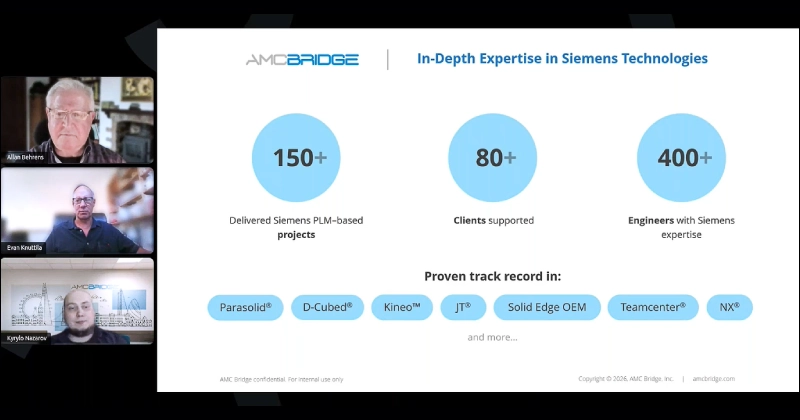
This expertise allows AMC Bridge to design and implement solutions that fully leverage Parasolid’s strengths, ensuring accuracy, scalability, and smooth interoperability in real production environments.
- Cloud-Based AEC Collaboration Platform Use Case
AMC Bridge used Parasolid as the unified geometry engine in a cloud‑native AEC ecosystem, allowing data from BIM, CAD, and parametric tools to stay synchronized and dependable across plugins and services.
Business impact:
- Consistent geometry across tools such as Revit, SketchUp, and Grasshopper
- Reliable multi‑plugin interoperability
- Scalable concurrent cloud processing
- Sheet Metal Manufacturing & Robotics Use Case
By implementing a Parasolid‑centric workflow for unfolding, manufacturability checks, and robotics simulation, AMC Bridge delivered a robust end‑to‑end solution for sheet metal engineering.
Business impact:
- Digital continuity from CAD import to robotic execution
- High‑fidelity bending and unbending operations
- Reduced manual fixes thanks to tolerance‑aware modeling
- Generative Engineering Platform Use Case
AMC Bridge developed a Parasolid‑powered desktop application for rapid, parameter‑driven geometry generation, enhanced through integrations with HOOPS Exchange and Visualize.
Business impact:
- Fast and stable geometry regeneration
- Effective design exploration guided by simulation feedback
- Smooth user experience through optimized background operations
“What makes Parasolid valuable for us is architectural reliability,” said Kyrylo Nazarov.
“When your workflow blends simulation, geometry analysis, manufacturing rules, and multi‑source data, you need a kernel that stays stable under real‑world load. Parasolid gives us that foundation.”
A Strategic Partnership Built on Technical Trust
As Evan added, “AMC Bridge has been a long‑time strategic partner for Siemens. Their engineers understand Parasolid’s capabilities at a deep technical level, and they’ve repeatedly proven their ability to help customers adopt PLM Components effectively. They’re a trusted implementation expert for teams building next‑generation 3D applications.”
This long-standing partnership enables customers to benefit from both Siemens’ product depth and AMC Bridge’s implementation expertise.
Looking Ahead
For organizations interested in exploring the latest advances in Parasolid and the broader Siemens PLM Components ecosystem, the upcoming PLM Components Innovation Conference 2026 offers a valuable opportunity to dive deeper into next‑generation modeling technologies and meet the teams shaping their future.
The AMC Bridge team will be delivering a dedicated session at the event, sharing insights from more than 150 projects delivered using Siemens PLM Components and demonstrating practical approaches to implementing Parasolid‑based solutions at scale.
If you’d like to connect with AMC Bridge during the conference or meet with our experts, please visit the Events page to request a meeting.
Acknowledgments and Helpful Links
We thank our speakers for their expert insights and the audience for their active participation and exciting questions asked during the Q&A session of the webinar.
For organizations evaluating Parasolid or planning their next steps, AMC Bridge offers both one‑on‑one technical consultations and dedicated engineering workshops. To arrange a meeting, please contact us at
For those who missed the live session, the full recording is available on AMC Bridge Webinars.
Insights summarized here reflect the views of the panelists and responses to audience questions during the live session.
All statements in this article are paraphrased summaries of the panel discussion and do not represent direct quotes unless explicitly indicated.
About Siemens Digital Industries Software
Siemens Digital Industries Software helps organizations digitally transform using software, hardware, and services from the Siemens Xcelerator platform. Its comprehensive digital twin technology enables companies to optimize design, engineering, and manufacturing processes to turn ideas into sustainable products. For more information, visit plm.sw.siemens.com and sw.siemens.com.
About AMC Bridge
AMC Bridge is a trusted software technology partner for engineering, manufacturing, and construction enterprises, whether they are actively pursuing AI-driven digital transformation or only beginning to recognize its potential. We help organizations to move beyond experimentation and achieve consistent ROI by delivering production-ready software and end-to-end solutions for their transformation journey.
We design, build, and integrate enterprise-grade software – applications, workflow extensions for CAD/PLM/BIM, data integrations, AI-enabled features – and deploy them with monitoring and lifecycle management so they remain reliable over time. Our services include assessing data readiness; preparing and unifying product and project data; and embedding AI into the workflows teams use every day. With 25+ years of industrial software expertise and deep ecosystem partnerships, including Aras, Autodesk, Bentley, Dassault Systemes, PTC, Siemens, Tech Soft 3D, and others, we empower enterprises to move confidently from experimentation to operational AI at scale. Learn more at www.amcbridge.com.